
The National Land Commission (NLC) is facing mounting internal discontent after employees raised concerns over what they describe as discriminatory pay cuts, declining staff morale and alleged irregular recruitment practices, claims that have intensified scrutiny of the constitutional commission responsible for managing public land.
Interviews with multiple staff members, alongside documents reviewed by this publication, paint the picture of a workplace grappling with low morale, uncertainty and growing frustration over decisions that employees say have disproportionately affected junior officers.
The concerns emerge at a time when many Kenyans are already struggling with the rising cost of living, making any reduction in employee benefits particularly significant.
House allowance cuts spark discontent
At the centre of the dispute are changes to house allowances for some categories of employees.
Payslips reviewed by this publication indicate that some lower-cadre staff experienced reductions in house allowances of up to 44 per cent, while some senior officers reportedly received increases of up to 70 per cent during the same period.
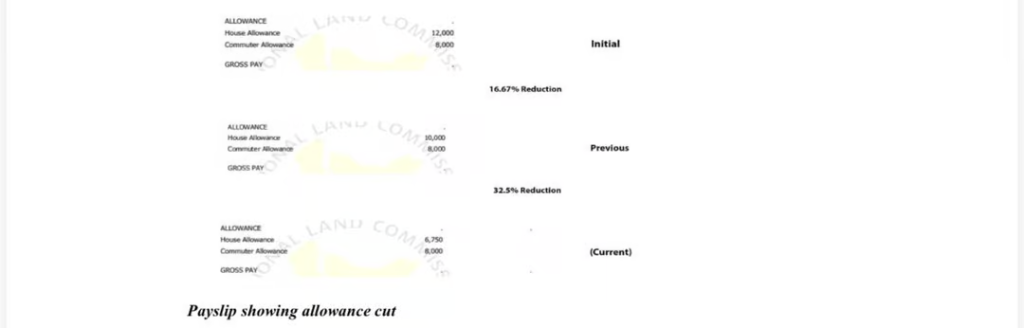
Employees who spoke on condition of anonymity claimed the adjustments were implemented without prior consultation or formal communication, leaving many to discover the changes only after receiving their monthly salaries.
Several staff members argued that the move had deepened perceptions of inequality within the institution.
Sources familiar with the matter alleged that the changes were introduced as part of efforts to manage the commission’s wage bill, although employees questioned why the burden appeared to fall disproportionately on lower job groups.
The commission had not publicly explained the rationale behind the reported adjustments by the time of publication.
Questions over recruitment
Beyond the salary concerns, employees also raised questions about recruitment processes at the commission.
Some staff alleged that certain appointments had not followed competitive recruitment procedures prescribed under Kenya’s labour laws, claiming that vacancies were sometimes filled without open advertisement or competitive interviews.
The allegations could not be independently verified.
Employees further claimed that the perceived lack of transparency had contributed to growing frustration among existing staff, who said opportunities for career progression appeared increasingly limited.
Concerns over workplace morale
Workers interviewed for this story described an atmosphere of anxiety, saying uncertainty over employment conditions had affected productivity across several departments.
Some employees claimed the institution’s working environment had deteriorated in recent months, with fears over future pay adjustments and career advancement weighing heavily on staff.
Because NLC employees are not unionised, several staff members said they have limited avenues through which to collectively challenge employment decisions.
Parliamentary scrutiny
The commission has in recent months faced increased oversight from Parliament on several governance matters.
Lawmakers previously directed NLC Chief Executive Officer Kabale Tache to submit recruitment data covering the period between 2023 and 2026 as part of parliamentary oversight into employment practices at the commission.
The outcome of that review has not yet been publicly communicated.
Legal questions
Employment law experts note that employers are generally expected to ensure fairness, transparency and non-discrimination in remuneration decisions.
Recent decisions by the Employment and Labour Relations Court have reinforced the principle that salary structures should not unfairly discriminate against particular categories of employees without lawful justification.
Whether the reported allowance adjustments at NLC meet that legal threshold would ultimately depend on the circumstances surrounding their implementation and any justification provided by the employer.
Calls for investigations
Some employees have appealed to oversight institutions, including the Ethics and Anti-Corruption Commission (EACC), the Ministry of Labour and relevant parliamentary committees, to examine the concerns raised regarding employment practices and human resource management at the commission.
They argue that an independent review would help establish the facts and restore confidence among staff.