Home Tags Posts tagged with "DCI"
Tag:

DCI

Fake fertilizer in Kakamega

Eight suspects have been arrested following the dismantling of a fertilizer adulteration and repackaging syndicate in Kakamega County, in a major crackdown by the Directorate of Criminal Investigations (DCI) targeting fraud in the agricultural sector.

The suspects were nabbed during an intelligence-led operation at Ejinja Village in Rurambi Sub-County, where detectives uncovered what they described as a processing and distribution hub for fake fertilizer products.

Taking to social media on Friday, March 20, 2026, DCI stated that those arrested include the alleged mastermind Napoline Murende Wakukha, alongside Isaya Chepkose Marende, Brivin Yeswa, Milkzadek Meja Nandwa, Martin Shilabula, Strola Deptica, Pascal Wathika Omusikoyo, and Jesca Bulimo.

“Eight suspects have been arrested following the dismantling of a suspected fertilizer adulteration and repackaging syndicate in Ejinja Village, Rurambi Sub-County, Kakamega County, after a targeted, intelligence-led operation by detectives,” DCI stated.

“The arrested individuals include the principal suspect, Napoline Murende Wakukha, alongside Isaya Chepkose Marende, Brivin Yeswa, Milkzadek Meja Nandwa, Martin Shilabula, Strola Deptica, Pascal Wathika Omusikoyo, and Jesca Bulimo.”

According to the DCI, a joint team drawn from its Operations Support Unit and Kakamega offices conducted the raid after weeks of surveillance and actionable intelligence.

Investigators established that the premises was being used to illegally handle and alter Government of Kenya (G.O.K) subsidized fertilizer intended for farmers.

“A joint team of detectives drawn from DCI Headquarters — Operations Support Unit and their Kakamega-based counterparts conducted the raid at a homestead that had been identified as a processing and distribution point for fraudulent fertilizer products targeting unsuspecting farmers,” the statement reads.

“The operation followed sustained surveillance and actionable intelligence, which established that the premises was being used for the illegal handling of Government of Kenya (G.O.K) subsidized fertilizer.”

During the operation, detectives recovered two vehicles, a Toyota Fielder and a Mazda CX-5, both loaded with fertilizer bags, some full and others empty.

A Mazda CX-5 that was intercepted. PHOTO/DCI/X

Authorities also seized large quantities of fertilizer of various brands, including UREA TOSHA labelled as subsidized fertilizer, YARA products, BORA BORA variants, MEA CAN, DAP, and CALCIGROW granules.

Of particular concern was fertilizer suspected to have been tampered with, including contents from 39 bags of OCP Africa TSP labelled as government-subsidized input.

A Toyota Fielder that was loaded with fertilizer. PHOTO/DCI/X

In addition, officers recovered empty branded bags, 48 packets of cement colour pigment believed to have been used to alter the appearance of fertilizer, and three sewing machines used for repackaging the products for resale.

Preliminary investigations indicate that the group targeted registered farmers by persuading them to redeem government-issued subsidy vouchers on their behalf in exchange for small incentives.

The fertilizer would then be diverted, adulterated using pigments to mimic high-value products such as DAP, repackaged, and sold at full market prices.

Detectives also suspect possible collusion with individuals linked to National Cereals and Produce Board (NCPB) depots in Voi and Webuye, which may have facilitated the irregular acquisition of subsidized fertilizer.

Authorities warned that such practices undermine government subsidy programmes, expose farmers to financial losses, and threaten agricultural productivity.

The scene has since been processed by Crime Scene Investigation personnel, with the suspects remaining in custody pending arraignment in court.

The DCI reiterated its commitment to protecting key government programmes from exploitation and ensuring those involved in economic sabotage are brought to justice.

Members of the public have been urged to remain vigilant and report any suspicious activities involving the illegal handling or sale of subsidized farm inputs.

0 comment
0 FacebookTwitterPinterestLinkedinTumblrWhatsappTelegramEmail
Office of the President, Harambee House

The Directorate of Criminal Investigations (DCI) has detailed how a sophisticated multi-million shilling fraud scheme targeting foreign investors was executed inside Harambee House, leading to the arrest of seven suspects.

In a press statement issued on Friday, March 20, 2026, the agency dismissed what it termed as “misleading and sensationalized” media reports, clarifying that no serving government officials were involved in the elaborate scam.

According to investigators, the fraud dates back to January 10, 2026, when a foreign investor, Talal Yousef Yousef Zaitoun of Swedish firm Jokara AB, received an unsolicited WhatsApp message from an individual identified as Stanley Ndawula.

Ndawula later linked the investor to Geoffrey Were, who allegedly posed as a consultant working with government agencies. The suspects then lured the investor into what appeared to be a lucrative government tender involving the supply of 500 Toyota Hiace High Roof ambulances.

“The Directorate of Criminal Investigations (DCI) wishes to set the record straight and strongly refute misleading and sensationalized headlines and reports appearing in sections of the media, particularly The Standard, concerning the arrest of seven individuals at Harambee House on 10th March, 2026,” the statement reads in part.

“Key facts of the matter are as follows: Mr. On 10th March, 2026, DCI detectives, acting on credible intelligence, arrested seven suspects who had illegally accessed a boardroom on the 12th floor of Harambee House. The suspects were masquerading as officials from the Ministry of Interior, National Treasury, Ministry of Health and had lured two foreign nationals Talal Yousef Yousef Zaitoun, representing M/S Jokara AB (a Swedish company), and his brother Mr. Hatem Youssef Yousef Zaitoun into a fictitious government tender for the supply of 500 Toyota Hiace High Roof Ambulances.”

On January 26, the investor travelled to Kenya and was received at the airport before being escorted to Harambee House. With the help of an accomplice, the suspects facilitated unauthorized access into the building.

Inside, the victim was ushered into a boardroom and introduced to individuals posing as officials from the National Treasury and Ministry of Health. He was presented with forged documents, including fake prequalification certificates allegedly signed by senior government officials.

The fraudsters offered two “investment packages,” with the victim opting for a USD 110,000 deal for multiple business opportunities.

Investigations reveal that on January 30, the victim transferred USD 110,000 to an account belonging to a law firm in Kenya.

On February 11, an additional USD 360,750 was wired under the pretext of insurance costs, bringing the total amount lost to USD 470,750 (over KSh 60 million).

The suspects later demanded an additional USD 1.08 million, prompting the victims to return to Kenya for further negotiations—unaware that detectives were already tracking the scheme.

On March 10, DCI detectives moved in and arrested the suspects inside a boardroom on the 12th floor of Harambee House, where they had again arranged a meeting with the victims.

Those arrested include Geoffrey Were Odondi, Michael Musyoki Ngumbi, Kororia Simatwa, Evans Simotwo, Allan Muthaiga Kariuki, Munialo Jared Masinde, and Purity Njeri Njiami.

DCI said Njiami, a former public servant, played a key role in facilitating unauthorized access to restricted areas but held no current government position.

The suspects were arraigned at the Milimani Law Courts on March 16, where they faced multiple charges, including conspiracy to defraud, obtaining money by false pretenses, forgery, and money laundering.

They pleaded not guilty and were released on a bond of KSh 5 million each or a cash bail of KSh 300,000 with two sureties. Their passports were confiscated, and the case is set for mention on April 1, 2026.

0 comment
0 FacebookTwitterPinterestLinkedinTumblrWhatsappTelegramEmail

By DCI

Abdinoor Sharmake Mohamed, the accused in a case of Conspiracy to Defraud and Giving False Information to a Person Employed in Public Office that involved a USD 394,209 fraudulent scheme has been charged at Makadara Law Courts.

The investigation of the case implicating him and three accomplices, Muna Dahir Dalmar, Salma Osman Gureye and Shamis Warsame Osman (the three at large), commenced in 2023, when the suspects reported at Pangani Police Station to have been defrauded the said amount by a businessman, who would later be vindicated by investigations as the victim of a fraud cartel.

In their fabricated allegations, the suspects claimed to have handed over USD 394,209 in cash to the businessman in 2022, money that constituted an investment in his company, African Express Cargo, and intended for a joint cargo business venture in Nairobi. They further alleged that upon receiving the funds, he had become evasive, failed to commence operations, and subsequently fled to a neighboring country. To substantiate their claims, the “complainants” produced an Acknowledgement of Debt dated 2nd May 2023, ostensibly executed by the businessman in the presence of an advocate.

Detectives from Starehe took over the investigation, profiled the alleged suspect before finally cornering him at JKIA in March, 2025. But on his arrest, a twist of events unfolded. Contrary to the reported complaints, the man claimed to have been abducted by individuals who posed as police officers, illegally detained, seizure of his passport and compulsion under duress to execute the debt agreement. He further alleged to have been forced to pay USD 17,000 to secure his release and passport, and a further USD 30,000 under threat of deportation.

The new information prompted a painstaking investigation, which disproved the earlier reported case. It emerged that the report at Pangani Police Station was fabricated by the daring suspects to boost their fraudulence art. Detectives unearthed that the victim was not in the country on the dates said to have committed the fraud offence, and neither were the three suspects who are still at large. Further, there was no record of either party’s presence at the Nairobi hotel where the transactions were reported to have taken place.

The case file was forwarded to the ODPP, who found the reported case to constitute a deliberate provision of false information to public officers, executed with the specific intent to coerce, extort, and pervert the course of justice.

Consequently, Abdinoor Sharmake Mohamed was hunted down, arrested and charged vide MCCR No E1091/2026 in respect of the aforementioned offences, but his three counterparts holed up. They are being sought.

0 comment
0 FacebookTwitterPinterestLinkedinTumblrWhatsappTelegramEmail
Safaricom

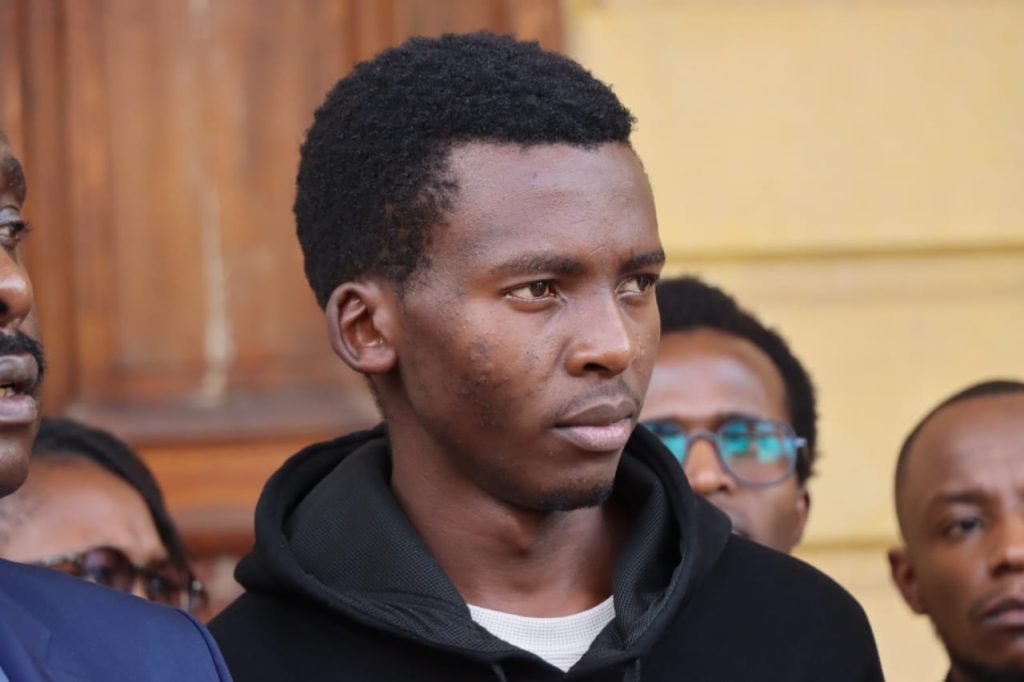
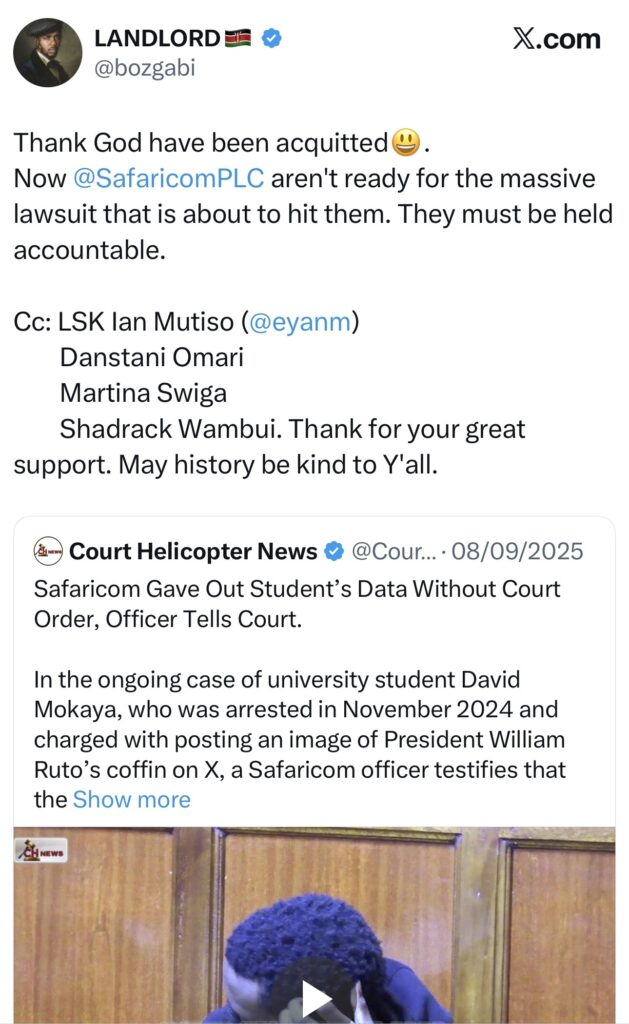
The acquittal of Moi University student David Mokaya by the Milimani Law Courts has opened a legal Pandora’s box that threatens to embarrass both Kenya’s dominant telecommunications company and the Directorate of Criminal Investigations in equal measure, as the young man’s lawyers announced plans to pursue the State for malicious prosecution while the court itself placed Safaricom on notice over what it described as a blatant and illegal breach of a subscriber’s constitutional rights.

Magistrate Caroyne Mugo, in a ruling delivered on February 19, 2026, did not merely acquit Mokaya of charges that he published false information about President William Ruto.

She went further, pointedly flagging Safaricom as a company with serious questions to answer after it emerged during trial that the telecommunications giant had surrendered Mokaya’s private subscriber data to police investigators without any court order authorising the disclosure.

The magistrate’s remarks were not obiter.

They were deliberate, targeted and carry the weight of judicial censure that Safaricom’s legal and regulatory affairs teams will find impossible to ignore.

David Mokaya outside Milimani Courts after being acquitted.

The facts of the case, as they emerged during weeks of testimony, paint a disturbing picture of a security apparatus that moved with remarkable speed and remarkable disregard for constitutional safeguards once a social media post touching on the President’s name entered the system.

On November 13, 2024, a post appeared on platform X under the username “Landlord @bozgabi” depicting a funeral procession with a military escort carrying a casket draped in the Kenyan flag, accompanied by a caption that investigators said referenced President Ruto.

Within twenty-four hours, a senior police officer identified in court as Michael K. Sang had written directly to Safaricom demanding the subscriber details behind the account.

By November 15, a team of detectives from the Serious Crimes Unit had descended on Eldoret, tracked Mokaya to an area opposite Moi University’s Annex, and arrested him.

A Samsung phone, a laptop and his identity card were seized before anyone had troubled themselves to obtain a search warrant.

It was Chief Inspector Bosco Kisau who delivered the most damaging admissions from the prosecution’s own witness stand.

Under cross-examination by defence lawyers Danstan Omari, Ian Mutiso and Shadrack Wambui, Kisau conceded that he had not been served with a court order authorising the investigation of Mokaya’s devices. He admitted he was unaware of a High Court ruling requiring law enforcement to obtain judicial authority before compelling mobile service providers to release subscriber details.

He further admitted that he could not confirm the origin, source or geographic location of the disputed post.

He could not confirm whether the SIM card linked to the account had been properly registered. He had not recorded a statement from the complainant, President Ruto.

And crucially, when pressed directly, he conceded that the post in question did not actually contain a photograph of the President.

Safaricom employee Daniel Hamisi, who also took the stand, confirmed that he had released Mokaya’s details upon a written request from a senior police officer, without any court order having been presented or demanded.

His testimony crystallised what civil liberties advocates have long argued: that Kenya’s Data Protection Act of 2019 and the constitutional right to privacy exist on paper in a manner that is, in practice, subordinate to a phone call or a letter bearing a senior officer’s signature when matters touching on political figures are involved.

The magistrate was unsparing.

She found that police had failed miserably in their duty, that the accused had been framed, and that no direct evidence linked Mokaya to the alleged offence.

She noted that Mokaya’s social media account was shared with three other individuals who were never traced or called as witnesses, creating reasonable doubt that could not be resolved by the prosecution’s threadbare evidence.

She noted that the alleged offence was said to have been committed in Nairobi while Mokaya was physically in Eldoret.

She noted the complete absence of forensic or digital evidence tying him to the post. She observed that the court could not rule out the possibility that the post itself had been fabricated and planted on an account associated with his name.

She also noted something that ought to concern the leadership of the Safaricom corporation and its board.

The company’s compliance with an unlawful police request, without demanding judicial authorisation, may constitute a violation of the Data Protection Act.

That legislation imposes clear obligations on data controllers and processors regarding the circumstances under which personal data may be disclosed to third parties, including law enforcement.

Disclosure without a court order, in circumstances where one is legally required, is not a procedural technicality.

It is a substantive breach carrying potential regulatory consequences from the Office of the Data Protection Commissioner and civil liability in the courts.

Omari and Mutiso, who led Mokaya’s defence and who are no strangers to high-profile constitutional litigation, wasted no time in signalling what comes next.

They told the court after the ruling that they intend to sue the State for malicious prosecution. Legal analysts familiar with their track record consider this not an idle threat but a certainty.

A malicious prosecution claim would require establishing that the prosecution was initiated without reasonable and probable cause, that it was actuated by malice, and that it terminated in the accused’s favour. On the facts as found by the magistrate, all three elements appear to be richly available.

The civil suit, when filed, will almost certainly name Safaricom as a defendant or at minimum as a party from whom discovery is sought.

The company will need to account for its internal processes around law enforcement data requests. It will need to explain why its compliance team released subscriber data without demanding what the law requires.

It will need to address whether this was an isolated incident or systemic practice. These are questions that Safaricom’s corporate communications machinery cannot deflect with a press statement.

For Mokaya himself, the personal cost of this ordeal is not easily quantified.

He was charged on November 13, 2024, and the case dragged through a full trial over a period of roughly three months.

His lawyer told the court that the student could not even speak in the immediate aftermath of the ruling due to mental trauma and shock that had gripped him since his arrest.

He spent the duration of the case on a bond of one hundred thousand shillings or a cash bail of fifty thousand shillings, money that a finance student at a public university would not easily produce. His devices were confiscated. His movements were constrained. His studies were disrupted.

The broader significance of this case extends well beyond one young man’s acquittal.

It arrives at a moment when the relationship between digital speech, state power and telecommunications infrastructure is under intense scrutiny across Africa.

Kenya’s Data Protection Act was celebrated when it passed as a significant step toward aligning the country with international data protection standards.

The Mokaya case suggests that the legislation’s practical force remains weak in the face of political pressure and institutional habit.

When a senior police officer can write a letter to a telecommunications company on a Tuesday and have subscriber location data by Wednesday morning without a magistrate or judge having been involved at any point, the statute’s protections are nominal at best.

The Law Society of Kenya, through Mutiso’s involvement in the case, has effectively placed its institutional weight behind the argument that telecom companies must resist unlawful data requests regardless of who is making them and regardless of whose name appears in the underlying social media post.

That argument will now be tested in the civil courts, where Mokaya’s lawyers say they will press it with full force.

Safaricom has not issued a public statement on the matter at the time of publication.

The company, which controls the overwhelming majority of Kenya’s mobile subscriber market and whose M-Pesa platform is embedded in the economic life of tens of millions of Kenyans, has significant reputational exposure if the civil litigation proceeds and produces further uncomfortable disclosures about the ease with which law enforcement has historically been able to extract personal data from its systems.

The magistrate reminded police, in terms that deserve to be read widely, that the duty to observe the law does not diminish because the name of the President or any other powerful figure appears in a social media post.

She reminded them that cases of this nature must be handled with caution and free from public or political pressure.

She reminded them that the criminal procedure code and the Constitution are not suspended when someone posts something uncomfortable about a head of state.

For a twenty-four-year-old finance student from Moi University who spent months answering charges that a court ultimately found may have been built on a fabricated foundation, those reminders came at significant personal cost.

The question that will now occupy Kenya’s legal community is whether the institutions that failed him will be made to pay one.

0 comment
0 FacebookTwitterPinterestLinkedinTumblrWhatsappTelegramEmail
Mohammed Noor Muhyadhin Mohammed

Detectives from the Operation Support Unit (OSU) have arrested a second suspect in connection with the Sh28 million fake gold scam that defrauded an American national of USD 217,900 in a botched 495-kilogram gold deal.

The suspect, Mohammed Noor Muhyadhin Mohammed, was apprehended in Nairobi as investigators widened the probe into what authorities describe as a well-coordinated money laundering network.

Funds Traced to Business Account

Investigations revealed that on February 3, 2026, Mohammed allegedly received USD 217,900 through his company, Mohazcom Trading, into an account held at the National Bank of Kenya.

The funds had reportedly been debited from accounts belonging to MOAC Advocates at the same bank and were purportedly payment for 495 kilograms of gold that was never delivered to the victim.

Detectives say that shortly after the funds were credited, Mohammed wired the entire amount to accounts held by Tecno Mobile Limited at Citibank in Hong Kong. The transfer was allegedly meant to facilitate a new shipment of mobile phones, which investigators say has yet to arrive in Kenya.

Alleged Forex Bureau Link

Further inquiries established that Mohammed has maintained a business relationship spanning more than a decade with a forex bureau located along Standard Street in Nairobi.

Investigators believe the forex bureau may have played a key role in facilitating substantial cross-border transfers, including the transaction now under investigation.

Authorities are examining whether the transfers exhibit classic indicators of money laundering, including layering and rapid offshore movement of funds.

Connection to Earlier Arrest

Mohammed’s arrest follows the earlier arraignment of Willis Onyango Wasonga, also known as “Marcus,” who was presented before the Milimani Law Courts on February 16, 2026.

Wasonga was charged with conspiracy to defraud, obtaining money by false pretences, and multiple offences under the Proceeds of Crime and Anti-Money Laundering Act (POCAMLA). He pleaded not guilty and was granted a bond of Sh1 million with two contact persons or an alternative cash bail of Sh350,000.

Alleged Cover-Up Attempts

In what detectives describe as an attempt to legitimise the transfer of USD 217,900, MOAC Advocates reportedly presented a debt settlement agreement allegedly signed by Mohammed and another suspect still at large.

However, investigators have since determined that the document was allegedly designed to create the appearance of a legitimate transaction and conceal fraudulent activity.

More Suspects Pursued

Mohammed remains in custody undergoing processing pending arraignment, while detectives pursue three additional suspects believed to be linked to the scheme.

The Directorate of Criminal Investigations (DCI) says the case underscores its ongoing commitment to dismantling gold scam syndicates and combating money laundering networks that exploit international investors and damage Kenya’s commercial reputation.

Authorities have urged members of the public to report suspicious gold transactions and financial crimes through anonymous reporting channels as investigations continue.

0 comment
0 FacebookTwitterPinterestLinkedinTumblrWhatsappTelegramEmail
Cyrus Jirongo's final moments

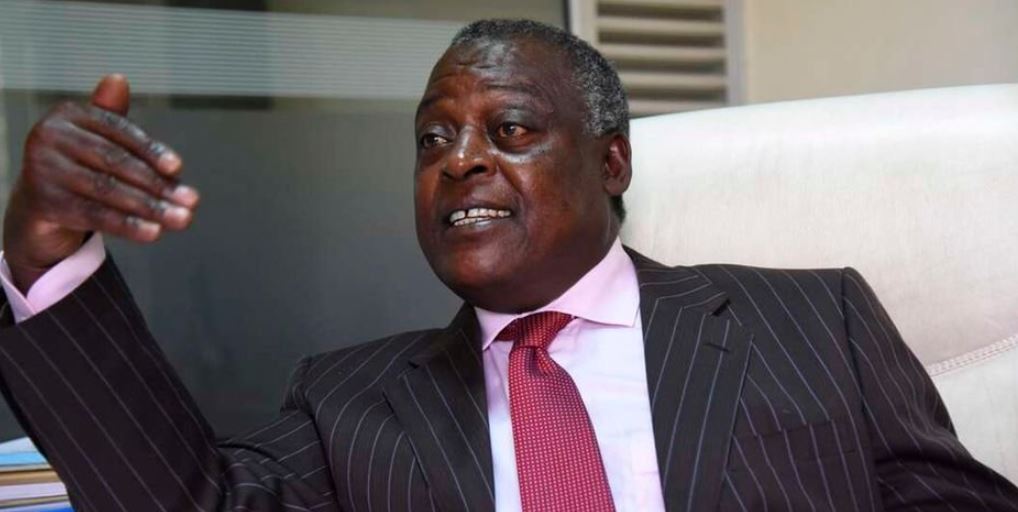
The late politician Cyrus Jirongo’s final moments have taken a dramatic turn after new details suggested that he was most likely being trailed before he met his death in a tragic accident at Karai, along the busy Nairobi-Nakuru Highway.

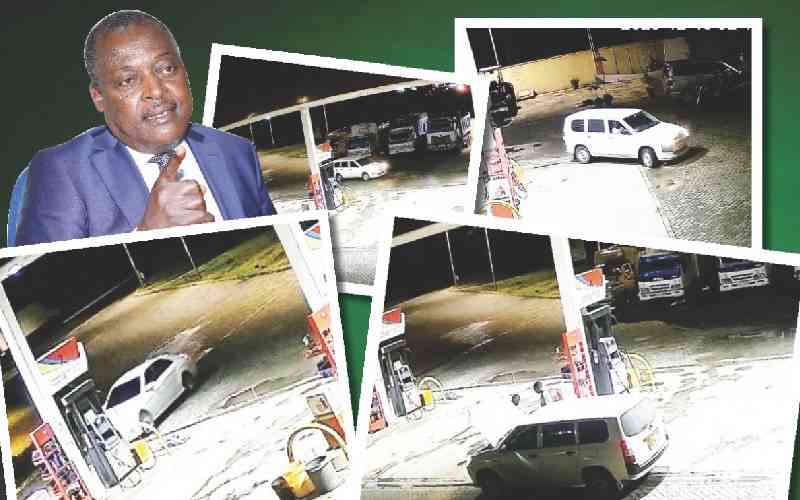
As the police focus on Park Place along Magadi Road in Karen, the last known location Jirongo visited before the fatal crash, a proper analysis of the CCTV footage has exposed more details, raising further questions about the circumstances that led to the fatal crash of Jirongo.

Jirongo had reportedly spent the evening at Karen Oasis with National Assembly Speaker Moses Wetang’ula and city real estate mogul Rebman Malala before telling friends he was heading home to Gigiri.

Cyrus Jirongo
Cyrus Jirongo

However, questions are now being raised about the final movements of Jirongo, including a white Probox seen in the CCTV footage.

The CCTV footage that was analysed by the Directorate of Criminal Investigations (DCI) detectives investigating the matter shows Jirongo’s Mercedes Benz vehicle entering a petrol station at about 2:18 a.m., then making a U-turn before rejoining the highway, where a bus later collided head-on with his car.

Separate footage now shows a Toyota Probox entering the station seconds before the crash, which has raised questions in public discussions of the final moments of Jirongo.

On Saturday, December 13, 2025, at dawn, a white car drove into the petrol station right behind Jirongo without fuelling and stopped at pump number two.

It had three men, as seen in the CCTV footage. One of them got out and walked to where Jirongo’s car had been and then returned. A second man stepped out and walked to the co-driver’s door as a third man peeped out of the car.

It was at that time that the accident, according to CCTV footage, happened. The coincidence raises fresh questions about a car seeking no service at a station and being followed by the death of a prominent personality.

Cyrus Jirongo’s autopsy

Family pathologist Joseph Ndung’u on Wednesday, December 17, 2025, revealed that Jirongo died from a blunt force trauma that caused severe injuries to the chest, abdomen, spine, and legs.

Jirongo succumbed to injuries sustained in a road traffic accident involving his Mercedes-Benz and a Climax Coaches bus at the Karai area along the busy Nairobi-Nakuru highway.

DCI Investigations into Jirongo’s death

The DCI on Tuesday, December 16, released new details into the circumstances surrounding the death of Jirongo, and revealed that it had kicked off a probe into his death.

The DCI stated that the collision occurred at approximately 2:19 a.m., resulting in a head-on collision. Investigators say the force of the crash pushed Jirongo’s vehicle about 25 metres from the point of impact, while the bus came to rest roughly 50 metres away.

A combined team of homicide detectives and forensic experts from the National Forensic Laboratory visited the scene, documented evidence, and secured key exhibits. Among the critical evidence recovered was CCTV footage from Eagol Petrol Station, located near the crash site.

According to the DCI, preliminary analysis of the footage shows that at 2:18:40 a.m., Jirongo drove into the petrol station from the Nairobi direction but did not refuel. At 2:19:10 a.m., his vehicle stopped at the station’s exit before making a right turn back towards Nairobi at 2:19:19 a.m.

Moments later, at 2:19:25 a.m., the CCTV captured the PSV bus ramming into his vehicle.

Detectives have interrogated the bus driver, Tyrus Kamau Githinji, who had earlier recorded a statement at the Naivasha Traffic Base. He has been released on cash bail pending further investigations into the offence of causing death by dangerous driving.

0 comment
0 FacebookTwitterPinterestLinkedinTumblrWhatsappTelegramEmail
SHA fraud

The Directorate of Criminal Investigations (DCI) has intensified its crackdown on fraud within Kenya’s healthcare system, unveiling major progress in ongoing investigations targeting facilities audited by the Social Health Authority (SHA).

In an update released on Wednesday, December 17, 2025, regarding the probe, detectives from the Investigations Bureau at DCI headquarters confirmed that they are conducting a wide-ranging investigation into alleged fraudulent activities involving medical facilities across the country.

The facilities under scrutiny are located in Nairobi, Homa Bay, Wajir, Kilifi, Kakamega, Bungoma, Busia, Kisumu, Vihiga, and Kajiado counties.

According to the DCI, 18 case files have already been forwarded to the Office of the Director of Public Prosecutions (ODPP) for review and legal direction. Of these, the ODPP has approved the prosecution of nine cases, marking a significant step forward in holding suspects accountable.

Meanwhile, five additional case files are still awaiting review and guidance from the ODPP, while three files have been returned to the DCI for further investigations. Investigators are also working on seven more case files that are yet to be completed before submission to the ODPP.

“So far, 18 case files have been forwarded to the Office of the Director of Public Prosecutions (ODPP) for review and legal guidance. The ODPP approved the prosecution of 9 cases, while 5 more case files are waiting for review and advice from the ODPP. Additionally, 3 case files have been returned to the DCI for further investigations, and 7 case files are still being investigated before being submitted to the ODPP for review and guidance,” the DCI stated.

In total, 24 suspects drawn from various medical facilities across multiple counties have so far been charged, as authorities signal that the net is widening and more arrests could follow.

The DCI reiterated its firm commitment to protecting public resources and restoring integrity in the healthcare sector, warning that no individual or institution involved in the alleged fraud will be spared.

0 comment
0 FacebookTwitterPinterestLinkedinTumblrWhatsappTelegramEmail
Cyrus Jirongo

The autopsy results on the body of former Lugari MP Cyrus Jirongo have been released.

Family pathologist Joseph Ndung’u on Wednesday, December 17, 2025, revealed that Jirongo died from a blunt force trauma that caused severe injuries to the chest, abdomen, spine, and legs.

Jirongo succumbed to injuries sustained in a road traffic accident involving his Mercedes-Benz and a Climax Coaches bus at Karai area along the busy Nairobi-Nakuru highway.

The Directorate of Criminal Investigations (DCI) on Tuesday, December 16, released new details into the circumstances surrounding the death of Jirongo, and revealed that it had kicked off a probe into his death.

The DCI stated that the collision occurred at approximately 2:19 a.m., resulting in a head-on collision. Investigators say the force of the crash pushed Jirongo’s vehicle about 25 metres from the point of impact, while the bus came to rest roughly 50 metres away.

“Preliminary investigations reveal that the accident involved Hon. Jirongo’s motor vehicle, registration number KCZ 305U, and a public service vehicle (PSV) bus, registration number KCU 576A, belonging to Climax Company Ltd. The collision occurred at approximately 02:19 A.M., resulting in a head-on impact that pushed the deceased’s vehicle about 25 metres from the point of impact, while the PSV bus came to a stop approximately 50 metres away,” the DCI stated.

A combined team of homicide detectives and forensic experts from the National Forensic Laboratory visited the scene, documented evidence, and secured key exhibits. Among the critical evidence recovered was CCTV footage from Eagol Petrol Station, located near the crash site.

According to the DCI, preliminary analysis of the footage shows that at 2:18:40 a.m., Jirongo drove into the petrol station from the Nairobi direction but did not refuel. At 2:19:10 a.m., his vehicle stopped at the station’s exit before making a right turn back towards Nairobi at 2:19:19 a.m.

Moments later, at 2:19:25 a.m., the CCTV captured the PSV bus ramming into his vehicle.

Detectives have interrogated the bus driver, Tyrus Kamau Githinji, who had earlier recorded a statement at the Naivasha Traffic Base. He has been released on cash bail pending further investigations into the offence of causing death by dangerous driving.

The driver is expected to report back to the Naivasha Traffic Base on December 22, 2025, for further police action.

0 comment
0 FacebookTwitterPinterestLinkedinTumblrWhatsappTelegramEmail

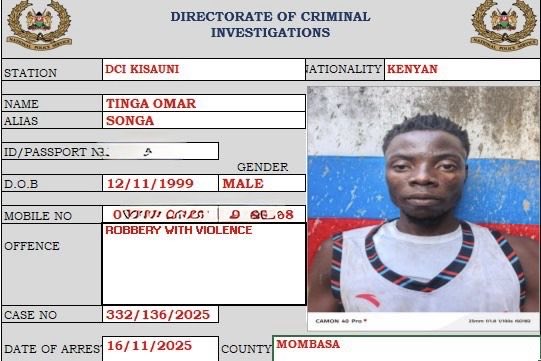
Police have arrested a man linked to a string of violent robberies in Kiembeni, Kisauni Sub-County in Mombasa County.

Directorate of Criminal Investigations (DCI), in a statement issued on Tuesday, December 16, 2025, said detectives based at Kisauni had arrested Omar Tinga, aka Songa, whom the officers have described as a notorious criminal long linked to a string of violent robberies.

“Kisauni Sub-County detectives have arrested Omar Tinga, aka Songa, a notorious criminal long linked to a string of violent robberies in Kiembeni,” the statement read in part.

According to the anti-crime agency, the arrest followed credible intelligence from members of the public, which led detectives straight to the suspect’s hideout in Bombo Village, where he was arrested.

Police further say Tinga is feared for his ruthless attacks on victims. He has been detained and is currently undergoing processing ahead of his court arraignment.

“The arrest followed credible intelligence from members of the public, which led detectives straight to his hideout in Bombo Village, where he was cornered and apprehended. Tinga is feared for his ruthless attacks on victims, leaving a trail of terror in his wake. He is currently in police custody, undergoing processing, pending arraignment,” the DCI stated.

0 comment
0 FacebookTwitterPinterestLinkedinTumblrWhatsappTelegramEmail
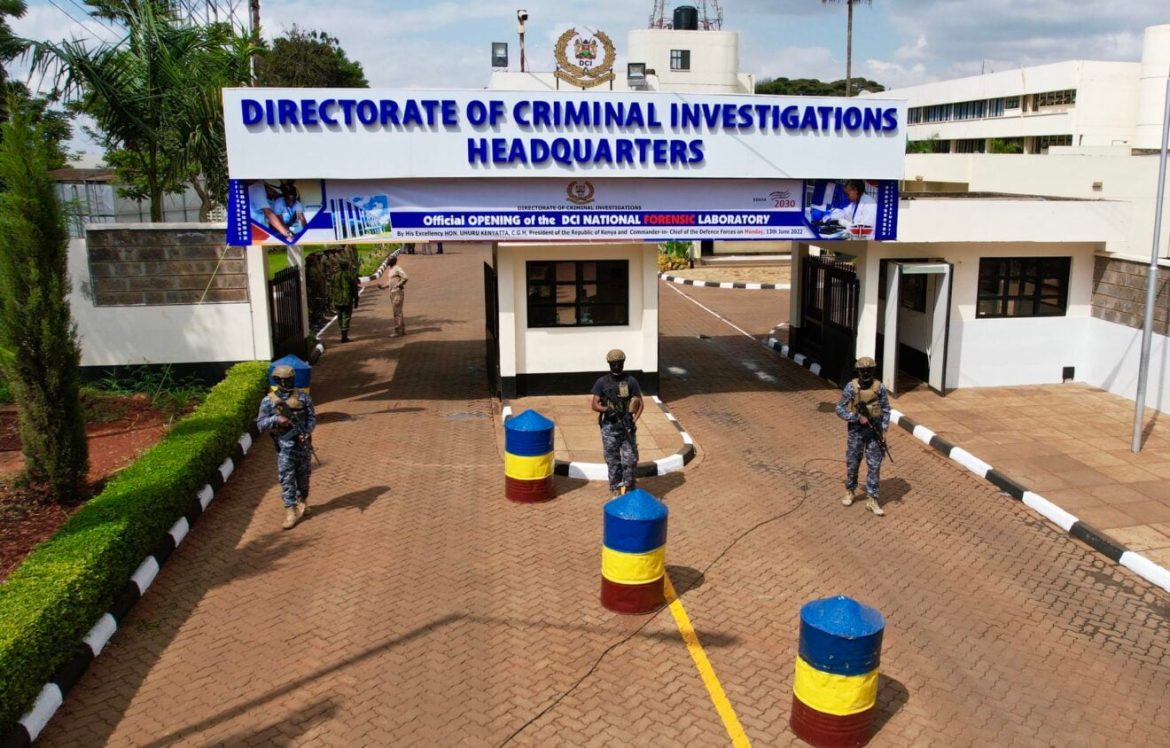
DCI Headquarters

The Directorate of Criminal Investigations (DCI) has released new details into the circumstances surrounding the death of former Cabinet minister and veteran politician Cyrus Jirongo, following a fatal road traffic accident along the Nakuru–Nairobi Highway.

In a press statement issued on Tuesday, December 16, 2025, the DCI confirmed that investigations are ongoing into the crash, which occurred in the early hours of December 13, 2025, at the Karai area in Naivasha.

Jirongo succumbed to injuries sustained in the accident.

“The Directorate of Criminal Investigations (DCI) has commenced investigations into the circumstances surrounding the death of Hon. Cyrus Jirongo, who succumbed to injuries sustained in a fatal road traffic accident that occurred on the night of 13th December 2025 at the Karai area along the Nakuru-Nairobi Highway,” the statement reads in part.

Cyrus Jirongo
Cyrus Jirongo

According to DCI, preliminary findings indicate that the accident involved Jirongo’s motor vehicle, registration number KCZ 305U, and a public service vehicle (PSV) bus, registration KCU 576A, owned by Climax Company Ltd.

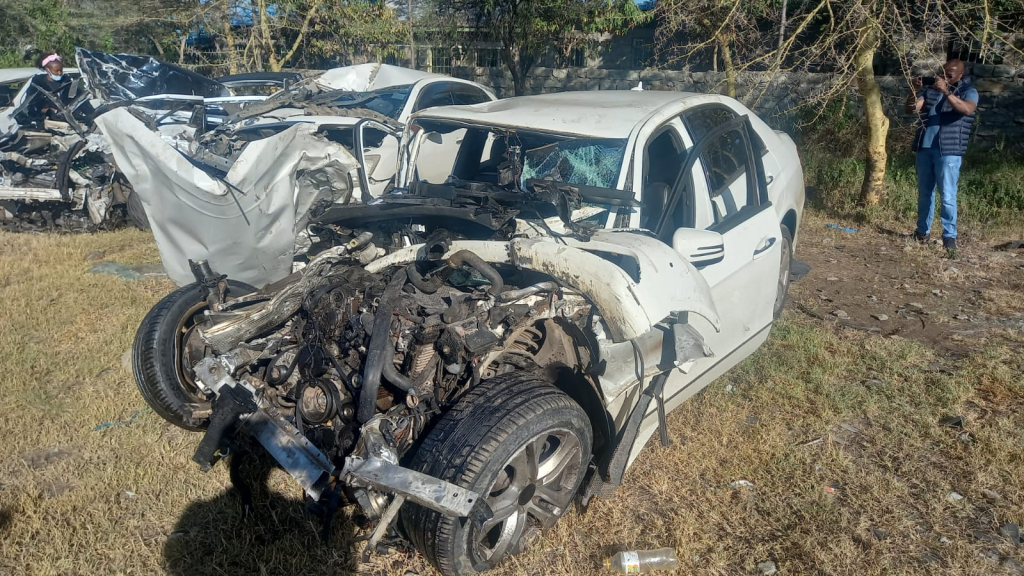
The collision occurred at approximately 2:19 a.m., resulting in a head-on impact. Investigators say the force of the crash pushed Jirongo’s vehicle about 25 metres from the point of impact, while the bus came to rest roughly 50 metres away.

“Preliminary investigations reveal that the accident involved Hon. Jirongo’s motor vehicle, registration number KCZ 305U, and a public service vehicle (PSV) bus, registration number KCU 576A, belonging to Climax Company Ltd. The collision occurred at approximately 02:19 A.M., resulting in a head-on impact that pushed the deceased’s vehicle about 25 metres from the point of impact, while the PSV bus came to a stop approximately 50 metres away,” the DCI stated.

CCTV Footage Recovered

A combined team of homicide detectives and forensic experts from the National Forensic Laboratory visited the scene, documented evidence, and secured key exhibits. Among the critical evidence recovered was CCTV footage from Eagol Petrol Station, located near the crash site.

According to the DCI, preliminary analysis of the footage shows that at 2:18:40 a.m., Jirongo drove into the petrol station from the Nairobi direction but did not refuel. At 2:19:10 a.m., his vehicle stopped at the station’s exit before making a right turn back towards Nairobi at 2:19:19 a.m.

Moments later, at 2:19:25 a.m., the CCTV captured the PSV bus ramming into his vehicle.

The wreckage of Cyrus Jirongo’s vehicle.

Climax Bus Driver Questioned, Released on Bail

Detectives have interrogated the bus driver, Tyrus Kamau Githinji, who had earlier recorded a statement at the Naivasha Traffic Base. He has been released on cash bail pending further investigations into the offence of causing death by dangerous driving.

The driver is expected to report back to the Naivasha Traffic Base on December 22, 2025, for further police action.

Witnesses and Forensic Review Ongoing

Investigators have also recorded statements from the petrol station’s night guard and fuel attendant, both of whom were on duty at the time of the incident. The forensic team is scheduled to revisit the scene for additional analysis as part of the ongoing inquiry.

Further, detectives are reconstructing Jirongo’s movements prior to the crash. This includes recording statements from individuals he had interacted with earlier in the night, notably those present during a meeting at Karen Oasis Bar and Restaurant in Nairobi.

Statements will also be taken from passengers aboard the Climax Company Ltd bus and other potential witnesses as investigators continue reviewing the CCTV footage.

File to Be Forwarded to DPP

Upon completion of investigations, the DCI says a comprehensive police file will be compiled and forwarded to the Director of Public Prosecutions (DPP) for review and guidance on possible charges.

0 comment
0 FacebookTwitterPinterestLinkedinTumblrWhatsappTelegramEmail
DCI Headquarters

What was meant to be a day of celebration and academic triumph turned into heartbreak and shock on Saturday after detectives from the Directorate of Criminal Investigations (DCI) dramatically halted an illegal graduation ceremony in Changamwe, Mombasa County.

Officers from the DCI Headquarters’ Serious Crime Unit (SCU), working alongside officials from the Commission for University Education (CUE), stormed Victory International Church where the ceremony was underway.

Graduands were already dressed in academic gowns, caps tossed in the air, and families gathered to witness what they believed was a milestone moment, before authorities abruptly brought the event to a stop.

The raid followed intelligence reports indicating that an unaccredited institution was conducting an unlawful graduation. Upon interrogation, the organisers, directors, and officials of Menorah Training Institute and Dominion Mission Theological University Global, a Ghana-based entity, failed to produce the mandatory accreditation documents from CUE.

Investigations revealed that Menorah Training Institute is only registered with the Technical and Vocational Education and Training Authority (TVETA) to offer courses up to diploma level.

However, the graduation list painted a troubling picture: five individuals were scheduled to receive master’s degrees, while seventeen others were listed for undergraduate degrees, qualifications that the institution is neither licensed nor authorised to confer.

DCI officials described the ceremony as a clear case of academic fraud, noting that unsuspecting students had been misled into believing they were earning legitimate degrees.

“As the ceremony progressed, it became evident that the institution was operating outside its mandate. The qualifications being awarded had no legal standing,” a detective involved in the operation said.

Six arrested

Following the disruption, six officials were arrested for their alleged role in organising the bogus graduation. Those taken into custody include Daniel Dela (President), board members John Kibet, Philomena Milano, and Ann Ogola Owiti, as well as Jason Oduor and Michael Ochieng. They are currently being processed pending arraignment in court.

As investigations continue, dozens of affected graduands were left devastated, their dreams of academic achievement abruptly cut short, serving as a painful reminder of the dangers of unverified institutions in the pursuit of education.

Watch the video in the DCI X post below:

0 comment
0 FacebookTwitterPinterestLinkedinTumblrWhatsappTelegramEmail

Directorate of Criminal Investigations (DCI) detectives from the Land Fraud Investigations Unit (LFIU) at DCI headquarters have apprehended a suspect involved in a high-value land fraud case.

The suspect allegedly forged a deed of gift and a transfer of land document to unlawfully acquire a parcel of land in the upscale area of Karen, valued at Sh200 million.

The case came to light when a complainant reported that she had purchased the land from the rightful owner, who had since passed away. This deceased owner had been bequeathed the said land by her late mother.

Following the complaint, detectives swiftly launched an investigation, which revealed that the suspect, identified as Benick Otieno Okombo, had crafted false documents purporting ownership of the land to be a gift from the deceased owner.

The meticulous inquiry collected the necessary evidence, which was then submitted to the Office of the Director of Public Prosecution. After an independent review, the ODPP supported the investigators’ findings and approved charges of forgery and the utterance of false documents against the suspect.

A manhunt ensued, leading to Okombo’s arrest at Bruce House, Nairobi, thanks to forensic leads. He is now in custody, undergoing processing in anticipation of his arraignment.

This arrest not only highlights the ongoing efforts in the fight against land fraud but also serves as a warning to those who might attempt similar deceitful acts.

0 comment
0 FacebookTwitterPinterestLinkedinTumblrWhatsappTelegramEmail
Fake police recruitment suspect arrested

Detectives in Kilimani have arrested a man believed to be the mastermind of a well-coordinated fake police recruitment racket that swindled unsuspecting job seekers out of Sh2.5 million.

The suspect, identified as Benedict Odeng’ero Wekesa, was apprehended on Wednesday at Sagret Hotel in Kilimani after three victims filed complaints detailing how they were duped with promises of guaranteed entry into the National Police Service.

According to the Directorate of Criminal Investigations (DCI), Wekesa allegedly used forged police recruitment letters to convince his victims that their slots in the service were already secured—if only they could pay. Each victim surrendered hefty sums, believing the “recruitment officer” was authentic and well-connected.

By the time the scam unravelled, a total of Sh2.5 million had exchanged hands.

Detectives, acting on intelligence, traced the suspect to his hideout, where he was arrested in a swift operation. During the raid, officers recovered 20 additional fake police recruitment letters, signalling what investigators believe is a broader, highly organised fraud network targeting desperate job seekers nationwide.

Wekesa’s accomplice, who was reportedly with him moments before the arrest, fled upon sensing danger and is currently being pursued.

The DCI has since warned the public to be wary of fraudsters posing as police recruiters, emphasising that genuine recruitment into the National Police Service is free, fair, and transparent, with no payments required at any stage.

“Anyone asking for money in exchange for a police job is a criminal,” the agency said.

Members of the public have been urged to report such cases immediately to the nearest police station or anonymously through the #FichuaKwaDCI platform. Reports can be made via toll-free hotline 0800 722 203 or WhatsApp on 0709 570 000.

Wekesa is currently in custody, undergoing processing, and will be arraigned once investigations are complete, as detectives follow new leads to track down his elusive accomplice.

0 comment
0 FacebookTwitterPinterestLinkedinTumblrWhatsappTelegramEmail

Detectives in Nairobi have arrested a man who had been posing as a Kenya Defence Forces (KDF) brigadier and allegedly fleecing unsuspecting youths with promises of military recruitment.

The suspect, identified as Joshua Mutui Muimi, was arrested in his rented apartment in Kilimani following an intelligence-led operation by Parklands-based officers. According to the Directorate of Criminal Investigations (DCI), Muimi had fashioned himself into a high-ranking military officer—despite having no ties to the disciplined forces—and used the disguise to lure desperate job seekers.

Inside the apartment, detectives found him fully dressed in Kenya Air Force regalia, complete with insignia reserved for senior officers. A search of the premises uncovered a stash of incriminating documents, including:

  • Six fake admission letters to the Recruit Training School (RTS) in Eldoret — all bearing the same serial number
  • Seven fingerprint forms used to convince victims the recruitment was legitimate
  • Documents branded with the Ministry of Defence logo
  • A Yilmaz Defence Industry ammunition-manufacturing manual
  • Additional materials believed to have been used to authenticate his scheme

Investigators believe Muimi has been running an elaborate con targeting young Kenyans seeking entry into the military, promising them placement in exchange for cash.

“He upgraded himself from a civilian to a ‘KDF brigadier’ without ever stepping foot on a parade square,” the DCI said, describing the scheme as a “money-minting spree built on false hope.”

The suspect is currently in custody, undergoing processing, and will be arraigned once investigations are complete.

The DCI has urged the public to avoid shortcuts in security-sector recruitment, stressing that all genuine KDF enlistments are free, fair, and transparent.

“Do not fall victim to impostors. Report suspicious individuals immediately,” the agency warned.

Daily Trends has been nominated for the Bloggers Association of Kenya (Bake) awards 2025, under the Topical Creator category. Your vote will help us bring this home. Please follow this link to cast your vote. It is absolutely free. The list of nominees will appear after you have keyed in your details. https://bakeawards.co.ke/vote

0 comment
0 FacebookTwitterPinterestLinkedinTumblrWhatsappTelegramEmail

A prominent Mombasa-based lawyer is among 22 suspects arrested in a sweeping counter-terrorism operation targeting financiers, recruiters, and facilitators of terrorism across the country.

Andrew Chacha Mwita was arrested on Friday, November 14, 2025, following a sting operation conducted by the Anti-Terrorism Police Unit (ATPU) in coordinated raids across Mombasa, Nairobi, Kapseret, Marsabit, and Moyale.

Authorities say Mwita is suspected of financing terrorism, with investigators linking him to transactions and networks believed to support extremist activities. He was presented before the Kahawa Law Courts on Monday, where detectives sought a 20-day custodial order to complete investigations. A ruling is expected on Wednesday, November 19, 2025.

The arrest is part of an intensified national crackdown aimed at dismantling terror support systems, a move the Directorate of Criminal Investigations (DCI) says is long overdue.

More Suspects in Court

Several other suspects arrested in Nairobi — Richard Muriuki Murimi, Said Galgalo Duba, Ali Mohamed, and Dhalha Abdi Mohamed — are also facing custodial applications. Their hearing was deferred to today, November 18.

In Kapseret, detectives tracked down and arrested Anthony Odhiambo Odwuor, whose custodial application ruling is set for November 25.

Meanwhile, in Mombasa, the courts will rule on November 26 on a 20-day custodial request for Miriam Ali Abdalla and Aisha Abdullahi.

Marsabit Sweep Produces Multiple Arrests

A major part of the operation unfolded in Marsabit County, where ATPU officers arrested seven suspects believed to be part of a broader network enabling terror activities in the northern region.

Those arrested include:

  • Fatuma Yabalo Guyo
  • Jilo Arafti Halake
  • Ajirena Halake Sora
  • Safia Ture Bidu
  • Kabale Duba Ali
  • Abdisalam Hassan Charfi

Investigators have sought 30 days to detain the group as they analyze intelligence, digital devices, and financial trails.

Hearings for the remaining seven suspects in the case continue today at the Kahawa Law Courts.

DCI: We’re Not Relenting

The DCI, through a statement on Tuesday, November 18, emphasized its commitment to rooting out terrorist networks.

“The Directorate of Criminal Investigations remains red-hot in the fight against terrorism and commits to leaving no stone unturned,” the agency said, urging the public to share information anonymously.

Kenyans were encouraged to report suspicious activities through the #FichuaKwaDCI hotline (0800 722 203) or WhatsApp (0709 570 000).

The sweeping arrests come amid increased coordination between intelligence agencies, ATPU, and local communities, signaling a tougher, more aggressive phase in Kenya’s counter-terrorism efforts.

Daily Trends has been nominated for the Bloggers Association of Kenya (Bake) awards 2025, under the Topical Creator category. Your vote will help us bring this home. Please follow this link to cast your vote. It is absolutely free. The list of nominees will appear after you have keyed in your details. https://bakeawards.co.ke/vote

0 comment
0 FacebookTwitterPinterestLinkedinTumblrWhatsappTelegramEmail

A British national’s romantic getaway in Mombasa turned into a nightmare after detectives uncovered a carefully staged robbery masterminded by a woman he had been courting online for months.

According to the Directorate of Criminal Investigations (DCI), the Briton had been wooed by the suspect, Samira Mumbi Kiarie, alias Samira, who charmed him with promises of affection and long-term love. Convinced he had finally found “the one,” the man travelled to her upscale Nyali apartment for what he believed would be a perfect date.

Instead, he walked straight into a scripted heist.

Minutes after he arrived, the apartment door burst open. Two men stormed in—one posing as Samira’s enraged husband, the other flashing a fake police ID.

The alleged “husband” accused the Briton of destroying his marriage, while the bogus cop threatened immediate arrest.

Terrified and confused, the victim was coerced into transferring Sh800,000 to mobile numbers provided by the gang. Once the money landed, the trio escorted him out of the apartment and disappeared into the night.

Detectives later revealed that the entire incident was an elaborate setup.

Acting on forensic intelligence, DCI sleuths launched an operation that led to the arrest of Samira and one of her accomplices, Paul Webster Mangeni, alias Paulo. Investigations have established that the pair belongs to a notorious syndicate targeting foreigners through dating sites, luring them to rented apartments, and robbing them.

“Investigations have since established that the two are part of a notorious syndicate that lures foreigners through dating sites, sets them up in Airbnbs, and robbing them of their hard-earned money,” the DCI stated.

Both suspects are in custody, undergoing processing ahead of their arraignment, while a manhunt is underway for their third accomplice, who remains at large.

The DCI has warned tourists and residents to be vigilant when engaging with strangers online, especially those who invite them into private residences.

0 comment
0 FacebookTwitterPinterestLinkedinTumblrWhatsappTelegramEmail