Home Tags Posts tagged with "Gold Scammers"
Tag:

Gold Scammers

Mohammed Noor Muhyadhin Mohammed

Detectives from the Operation Support Unit (OSU) have arrested a second suspect in connection with the Sh28 million fake gold scam that defrauded an American national of USD 217,900 in a botched 495-kilogram gold deal.

The suspect, Mohammed Noor Muhyadhin Mohammed, was apprehended in Nairobi as investigators widened the probe into what authorities describe as a well-coordinated money laundering network.

Funds Traced to Business Account

Investigations revealed that on February 3, 2026, Mohammed allegedly received USD 217,900 through his company, Mohazcom Trading, into an account held at the National Bank of Kenya.

The funds had reportedly been debited from accounts belonging to MOAC Advocates at the same bank and were purportedly payment for 495 kilograms of gold that was never delivered to the victim.

Detectives say that shortly after the funds were credited, Mohammed wired the entire amount to accounts held by Tecno Mobile Limited at Citibank in Hong Kong. The transfer was allegedly meant to facilitate a new shipment of mobile phones, which investigators say has yet to arrive in Kenya.

Alleged Forex Bureau Link

Further inquiries established that Mohammed has maintained a business relationship spanning more than a decade with a forex bureau located along Standard Street in Nairobi.

Investigators believe the forex bureau may have played a key role in facilitating substantial cross-border transfers, including the transaction now under investigation.

Authorities are examining whether the transfers exhibit classic indicators of money laundering, including layering and rapid offshore movement of funds.

Connection to Earlier Arrest

Mohammed’s arrest follows the earlier arraignment of Willis Onyango Wasonga, also known as “Marcus,” who was presented before the Milimani Law Courts on February 16, 2026.

Wasonga was charged with conspiracy to defraud, obtaining money by false pretences, and multiple offences under the Proceeds of Crime and Anti-Money Laundering Act (POCAMLA). He pleaded not guilty and was granted a bond of Sh1 million with two contact persons or an alternative cash bail of Sh350,000.

Alleged Cover-Up Attempts

In what detectives describe as an attempt to legitimise the transfer of USD 217,900, MOAC Advocates reportedly presented a debt settlement agreement allegedly signed by Mohammed and another suspect still at large.

However, investigators have since determined that the document was allegedly designed to create the appearance of a legitimate transaction and conceal fraudulent activity.

More Suspects Pursued

Mohammed remains in custody undergoing processing pending arraignment, while detectives pursue three additional suspects believed to be linked to the scheme.

The Directorate of Criminal Investigations (DCI) says the case underscores its ongoing commitment to dismantling gold scam syndicates and combating money laundering networks that exploit international investors and damage Kenya’s commercial reputation.

Authorities have urged members of the public to report suspicious gold transactions and financial crimes through anonymous reporting channels as investigations continue.

0 comment
0 FacebookTwitterPinterestLinkedinTumblrWhatsappTelegramEmail
James Mabele Magio

A budding politician eyeing the Budalangi constituency parliamentary seat in the 2027 general elections has been implicated in a sophisticated international fraud ring operating from Nairobi that has allegedly defrauded foreign investors of millions of shillings in fake gold deals.

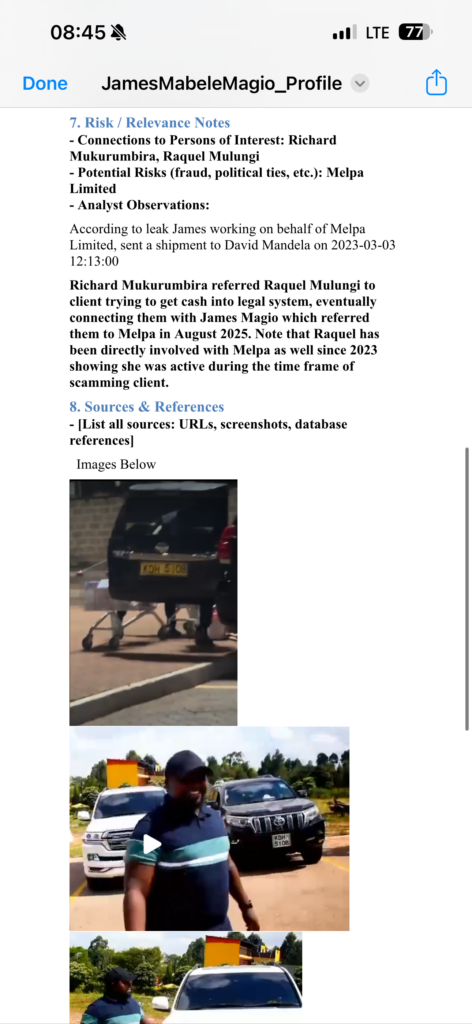
James Mabele Magio, who describes himself on social media as a news reporter and program presenter, has been identified in leaked intelligence documents as a key player in an elaborate scam involving a fake logistics company used as a front to lure unsuspecting buyers from Europe, the Middle East, the United States, and the United Kingdom.

The damning revelations come from confidential files by a whistleblower who claims intimate knowledge of the operation.

The dossier includes internal shipment databases, customer lists, email correspondence, and detailed intelligence profiles suggesting Magio worked as a fixer, connecting foreign clients to what appeared to be legitimate cargo shipments that investigators believe never existed.

At the heart of the scheme is Melpa Limited, a Nairobi-based company masquerading as an international freight forwarder with expertise in customs clearance and warehousing. The company’s polished website advertises decades of experience and lists a professional address near Jomo Kenyatta International Airport.

However, domain records examined by investigators reveal the site was only registered in 2023, with operators frequently shifting between hosting providers and recently settling on Swiss-based servers.

According to the leaked documents, victims were persuaded to wire large sums of money for freight charges, insurance premiums, clearance fees, and verification costs for sealed cargo containers supposedly containing gold bars awaiting export.

In one particularly egregious case documented in the files, a victim reportedly lost more than 100,000 dollars and was subsequently pressed to send an additional half-million dollars to allegedly release the phantom shipment.

The operational patterns mirror those of notorious gold scam rings that have made Nairobi what law enforcement officials describe as the global epicenter of precious metals fraud.

Nairobi’s illicit gold underworld is estimated to involve about $28 billion, according to research by the Global Initiative Against Transnational Organised Crime.

Detectives have repeatedly arrested individuals staging sophisticated fake gold operations using warehouses, branded packaging and counterfeit mineral certificates.

Last year in Lang’ata, officers recovered sand-filled boxes packaged as gold bullion alongside bogus assay reports and forged export papers.

In similar cases across the capital, foreign investors have lost hundreds of thousands of dollars for shipments containing scrap metal or stones.

The Melpa operation appears to represent an evolution of these techniques, featuring unprecedented levels of organization and international coordination.

Magio, who maintains an active social media presence promoting his political aspirations and charitable work through the Mabel Foundation, appears repeatedly in communication logs and shipment clearance documents provided to investigators.

The files suggest he allegedly acted as an intermediary, vouching for the legitimacy of transactions and facilitating connections between foreign clients and the fraudulent operation.

His public profile shows connections to media work in Western Kenya, including stints as a correspondent for Western Nyota TV and Radio and presenter at Bulala FM.

On Facebook, where he uses multiple accounts, Magio promotes his political ambitions for the 2027 parliamentary race in Budalangi, a flood-prone constituency in Busia County with approximately 66,723 residents.

He studied at Kenyatta University and runs business interests including what appears to be a Belaire champagne distributorship.

The intelligence dossier identifies several other alleged key figures in the network.

Markos S Baghdasarian, an Armenian American, appears in the documents with investigators noting his criminal history in the United States where public records show he once served prison time for involvement in shipping petroleum products to Iran without proper licensing while associated with Delfin Group Inc.

The whistleblower believes he now plays a strategic or financial role in coordinating the Nairobi operation.

Richard J Mukurumbira, identified as a UK-based associate, surfaces in email chains involving payment routing and offshore escrow arrangements.

Raguel Mungli, described as a Nairobi contact, allegedly coordinates client interactions and forwards the forged documents designed to reassure victims their shipments are genuine.

According to the leaked material, which includes a profile document dated with references to transactions from 2023, Mukurumbira allegedly referred Mungli to a client attempting to legitimize illicit funds, eventually connecting them with Magio who in turn directed them to Melpa in August of last year.

The documents note that Mungli had been directly involved with Melpa since 2023, demonstrating sustained criminal association during the period when clients were being scammed.

What makes this operation particularly alarming is its professional veneer.

The forged documents recovered by investigators include branded airway bills, export stamps, verification receipts and shipment movement logs that closely mimic legitimate cargo documentation.

The company website mirrors established freight firms in design and corporate language.

Even the business address appears to have been copied from a genuine logistics company in the city.

Most victims, especially those making contact from abroad, assume they are dealing with a reputable Nairobi freight handler.

The customer database raises additional red flags, with some names belonging to individuals previously associated with fraud investigations or suspicious business activity.

The whistleblower, who claims to have provided only a fraction of available evidence, believes Melpa represents merely one tentacle of a much larger network involving local and foreign actors, including businessmen, political aspirants and individuals with documented criminal records across multiple jurisdictions.

Kenya’s gold scam industry has grown increasingly sophisticated, bankrolled by networks that exploit weak regulatory oversight, fragmented international cooperation and the desperation of victims willing to believe Nairobi serves as a major hub for precious metals exports.

Recent high-profile arrests include US national Sergio Patrick Antonucci, charged in December 2024 with defrauding a businessman of over Sh674 million in a fake gold deal.

This case stands out for its corporate structure and global reach.

It employs a branded identity, international hosting infrastructure, coordinated digital records and individuals spanning multiple countries with varying criminal backgrounds. If the leaked documents prove authentic, Nairobi may be hosting one of the most organized precious metals fraud operations in recent years.

The revelations demand immediate investigation by the Directorate of Criminal Investigations’ Financial Crimes Unit, the Anti Narcotics and Organised Crime Directorate, Interpol’s regional desk and foreign agencies with jurisdiction over international fraud and money transfers.

DCI Director-General Amin Mohamed Ibrahim has acknowledged the scope of the problem, describing it as involving a huge cartel of Kenyans, Congolese, Liberians, Nigerians and Ghanaians operating in a very sophisticated manner.

Victims remain reluctant to speak publicly, which helps perpetuate the fraud.

The whistleblower claims to have lost contact with one victim who vanished after losing more than 100,000 dollars, allegedly pressured repeatedly to send additional money to release a shipment that likely never existed.

Multiple attempts by this publication to reach Magio for comment proved unsuccessful.

Calls to his listed mobile number went unanswered and messages sent via WhatsApp and social media platforms were not returned. Similarly, attempts to contact other individuals named in the intelligence report yielded no response.

The Mabel Foundation website and associated social media accounts show no indication of the allegations, instead featuring photographs of community outreach activities and political campaign materials positioning Magio as a grassroots leader committed to development in Busia County.

As Kenya grapples with its reputation as a haven for gold fraud, this case underscores how criminal networks are evolving beyond crude operations to adopt corporate facades and international coordination.

The whistleblower has indicated that more files exist, including bank transfer records and communications between alleged organizers, suggesting this investigation may only be beginning to expose the full scope of the operation.

For a politician seeking to represent one of Kenya’s most economically challenged constituencies, where the monthly mean household income hovers around Sh3,315 and residents struggle with annual flooding disasters, the allegations represent a devastating blow to credibility before the campaign has properly begun.

The question now facing investigators is whether James Mabele Magio will answer questions about his alleged role in an international fraud ring, or whether he will join the growing list of individuals connected to Kenya’s thriving fake gold industry who manage to evade accountability despite mounting evidence of systematic criminal enterprise.

0 comment
0 FacebookTwitterPinterestLinkedinTumblrWhatsappTelegramEmail
Gold scam suspect Abbas Bardu Omuyoma. PHOTO/@DCI_Kenya/X

Detectives from the Directorate of Criminal Investigations (DCI) Nairobi Regional Office have arrested Abbas Bardu Omuyoma, alias Ishmael, in connection with a multi-million shilling gold scam that defrauded a Canadian investor of USD 280,000 (approx. Ksh42 million).

The suspect was apprehended along Dennis Pritt Road in Nairobi, following weeks of forensic investigations and surveillance.

His arrest comes after the victim lodged a formal complaint on September 1, 2025.

The Gold Scam

According to investigators, Ishmael and an accomplice who is still at large lured the investor with promises of supplying 550 kilograms of gold nuggets and bars allegedly sourced from the Democratic Republic of Congo (DRC).

Believing he was entering into a legitimate business deal, the Canadian investor transferred the equivalent of USD 280,000 via USDT (Tether cryptocurrency). However, the gold consignment never materialised, and efforts to recover the funds proved futile.

The Arrest

Detectives launched an intensive probe, leveraging forensic leads to track Ishmael’s movements. On Monday, they intercepted and arrested him, bringing to an end weeks of evasion.

Currently in custody, Ishmael is undergoing processing pending his arraignment in court.

Hunt for Accomplice

DCI officers confirmed that a manhunt is underway for Ishmael’s accomplice, who is believed to have played a central role in the elaborate con.

The DCI has also urged members of the public and foreign investors to exercise caution when engaging in gold transactions in Kenya, warning that fraudsters continue to exploit unsuspecting victims using fake documents and false promises of Congolese gold.

0 comment
0 FacebookTwitterPinterestLinkedinTumblrWhatsappTelegramEmail

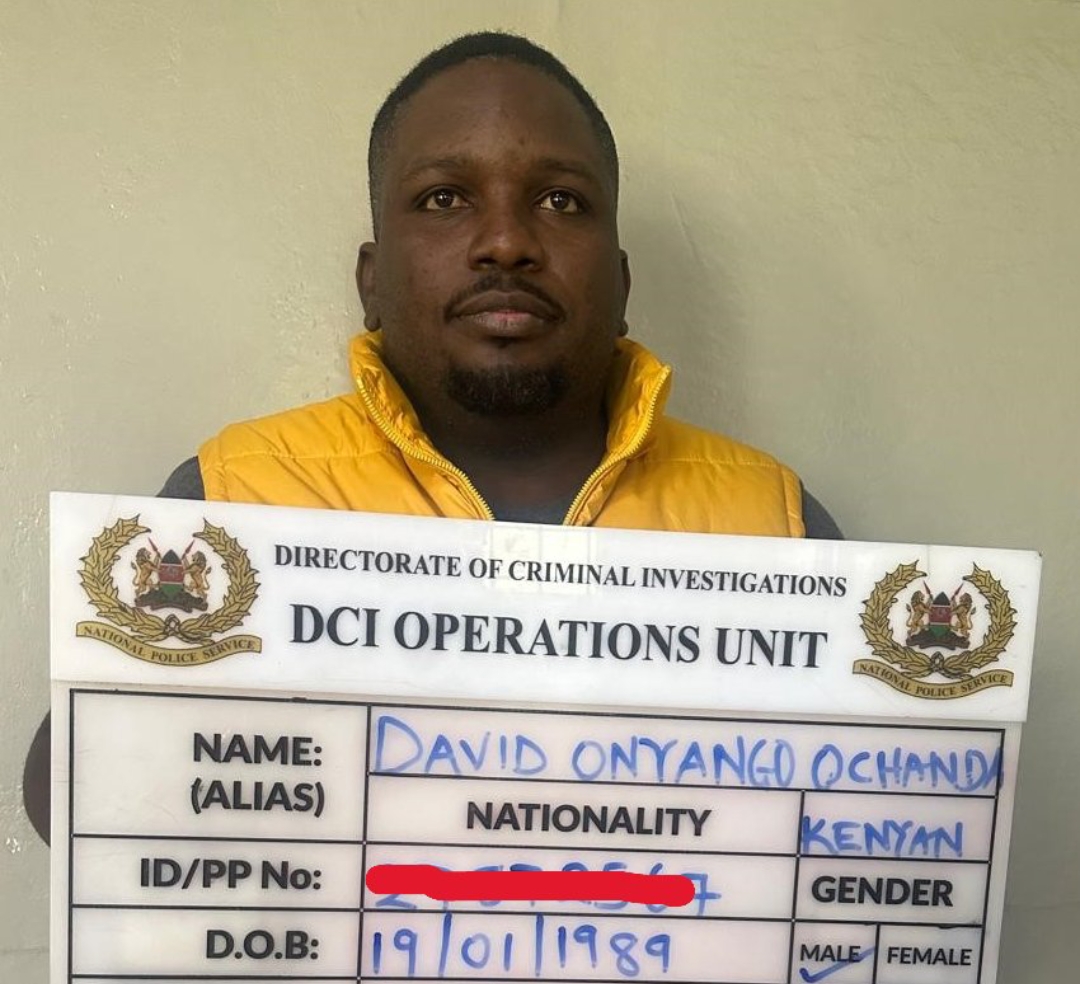
In a significant breakthrough, detectives from the Directorate of Criminal Investigations (DCI) Operations Support Unit have arrested David Onyango Ochanda, a notorious figure implicated in a sophisticated gold scam that defrauded an American investor of Ksh 29.3 million (USD 225,968.64).

The arrest, announced on Friday, August 15, 2025, marks a critical step in combating the rising tide of financial crimes in East Africa.

The Elaborate Scheme Unraveled

The scam, which dates back to April 3, 2024, began when the unsuspecting investor arrived in Kenya to finalize a deal for the purchase of 3,370 kilograms of gold.

Lured into a seemingly legitimate transaction, the investor was escorted to an office at Gate 53, Chalbi Drive in Lavington, Nairobi, where he signed a Sales and Purchase Agreement.

To bolster the illusion of authenticity, the scammers staged a smelting process at the seller’s agent’s office, a tactic increasingly documented in gold fraud cases across the region.

The plot thickened on April 25, 2024, when the investor was introduced to Toureg Insurance Brokers Limited, a registered Kenyan brokerage overseen by the Insurance Regulatory Authority (IRA).

David Onyango Ochanda, identified as the director of the company and the signatory to the account that received the funds, presented the firm as the entity responsible for insuring the gold during transit.

An addendum to the original agreement was signed, inflating the invoice to USD 226,012.76, of which USD 225,968.64 was wired by the investor on April 29, 2024. The gold, however, never materialized.

Coordinated Sting Operation

Today’s arrest followed a meticulously planned operation by DCI detectives, who had long had Ochanda on their radar.

The suspect is currently in custody and undergoing processing, with arraignment scheduled for Monday, August 18, 2025.

0 comment
0 FacebookTwitterPinterestLinkedinTumblrWhatsappTelegramEmail

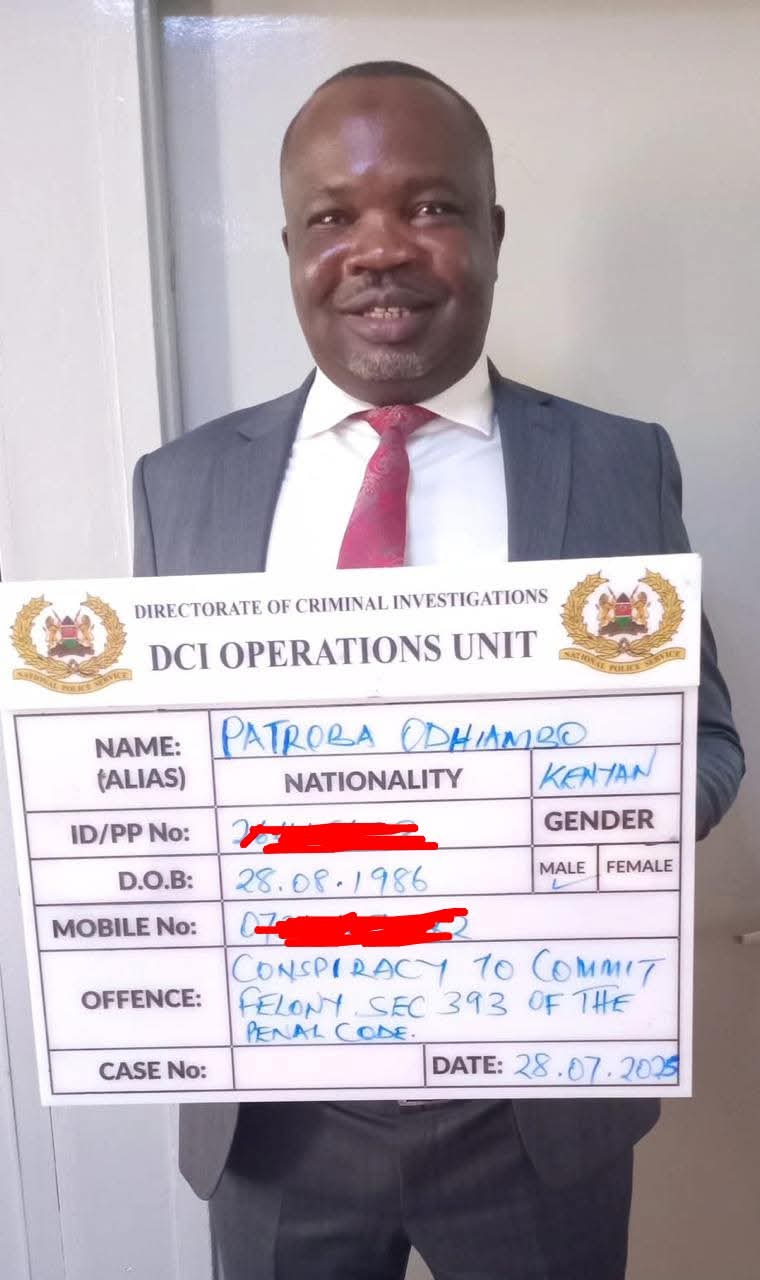
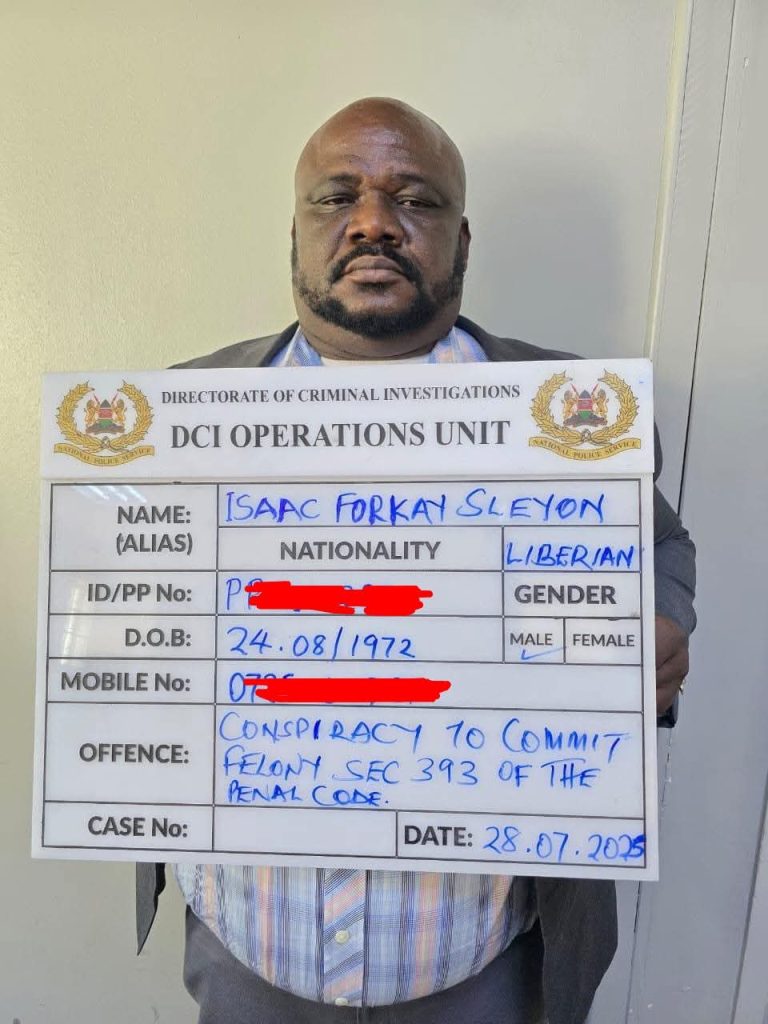
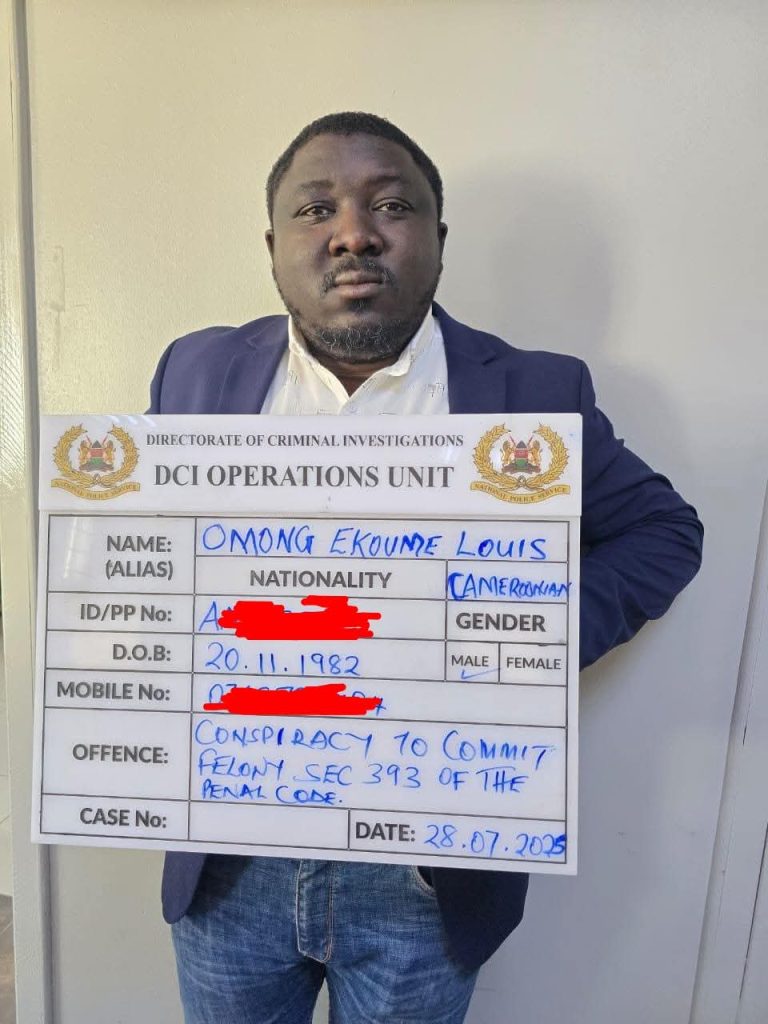
Detectives from the Operation Support Unit (OSU) of the DCI have arrested four individuals accused of perpetrating elaborate gold scams that have robbed unsuspecting victims of their hard-earned money.

The suspects: Patroba Odhiambo Tobias, Isaac Forkay Sleyon, Omong Ekoume Louis and Wadja Bangsi Tang, were taken into custody during a meticulously planned raid at a residence in Gigiri, situated along Whispers Avenue.

A thorough search of the premises uncovered a trove of incriminating evidence, including a gold smelting machine, an array of rubber stamps bearing the names of companies such as Alaska Express Freight Group Ltd, Longcrane Logistics Limited, and Kakan Traders and Company, numerous plastic seals, a weighing machine, and a cache of documents bearing stamp impressions from the East African Community, among other items.

Preliminary investigations have revealed that Alaska Express Freight Group Ltd has also been linked to a recent complaint involving two Canadian nationals who were defrauded of USD 37,500 last week.

The suspects are currently in custody and are undergoing processing in preparation for their arraignment.

0 comment
0 FacebookTwitterPinterestLinkedinTumblrWhatsappTelegramEmail