
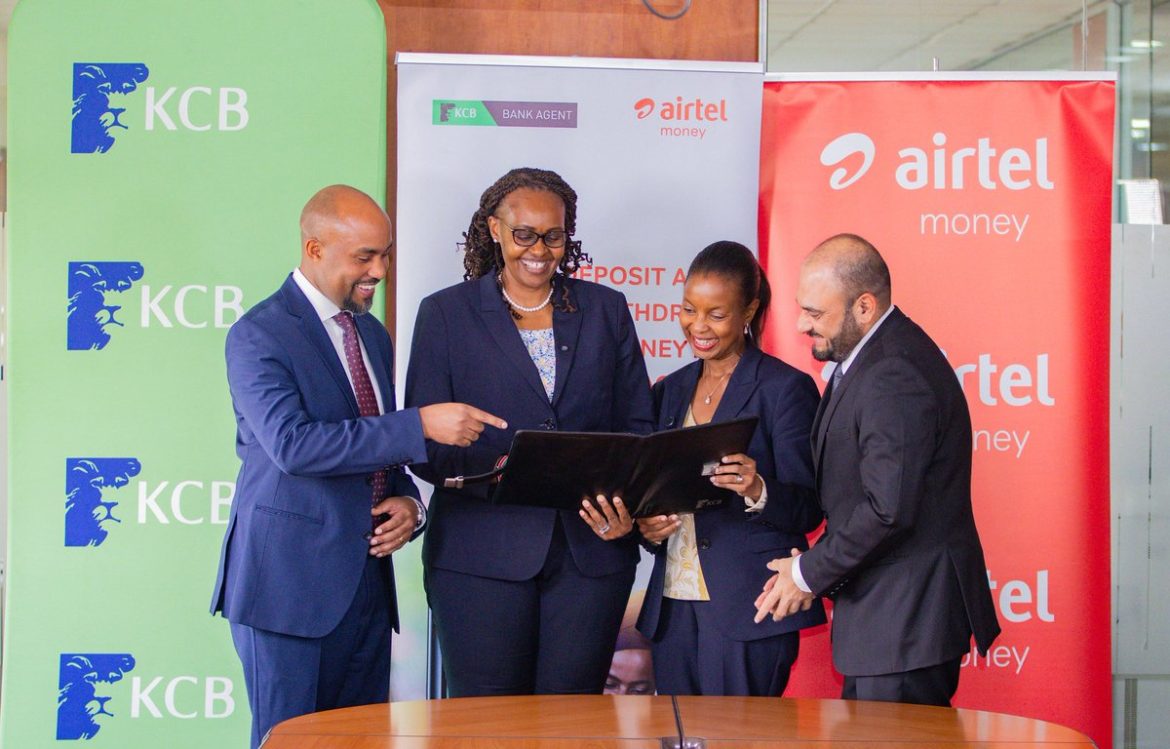
When two of Kenya’s most powerful financial institutions sit side by side, pens poised over a partnership agreement and smiling for the cameras, the language is predictable: inclusion, innovation, interoperability, ecosystem.
That was the public face of the new alliance between KCB Bank Kenya and Airtel Money Kenya—a deal granting Airtel Money access to over 22,000 KCB banking agents nationwide for deposits and withdrawals.
But beneath the polished press photos and carefully worded joint statements lies a deeper question this investigation refuses to ignore:
Is Kenya witnessing a breakthrough in financial inclusion—or the quiet consolidation of a private data empire over its money flows?
A market shift happening in real time
The timing of the deal is not accidental.
Over the past two years, Airtel Money has been steadily eroding Safaricom’s dominance in mobile money, growing its market share from roughly 3% to about 11% by late 2025. Its strategy has been simple but disruptive: lower fees, aggressive pricing, and free intra-network transfers.
For the first time in over a decade, M-Pesa’s dominance has shown cracks.
At the same time, the Central Bank of Kenya has repeatedly delayed full agent-level interoperability—a reform meant to ensure that any customer can transact at any agent regardless of network.
That failure has created a vacuum. And into that vacuum, private giants are stepping in.
“When public rails fail, private toll roads emerge”
In theory, Kenya’s payments architecture was supposed to become fully interoperable by 2024 under the National Payments Strategy.
In practice, that promise remains unfulfilled in 2026.
The result is a fragmented system where access is still controlled by networks, contracts, and corporate alliances—not public infrastructure.
The KCB–Airtel partnership effectively builds a parallel interoperability system, but one governed entirely by commercial logic.
As one Nairobi payments analyst put it:
“When the public rail doesn’t arrive, companies build toll roads. And they decide who pays—and who gets seen.”
What Airtel actually gained: instant infrastructure
For Airtel Money Kenya, the deal is transformational.
Instead of slowly building an agent network from scratch, Airtel now plugs into KCB’s massive 22,000-agent ecosystem overnight.
That means:
- Immediate nationwide cash-in/cash-out coverage
- Reduced liquidity and float management costs
- Faster competitive parity with dominant mobile money networks
But critically, the financial terms of the agreement remain undisclosed.
No public breakdown exists of:
- Revenue sharing per transaction
- Agent commission structures
- Float risk allocation
- Data-sharing arrangements
The silence is not incidental—it is structural.
What KCB actually gained: the invisible asset
For KCB Bank Kenya, the deal is far more strategic than it appears.
This is not just an agency expansion. It is a data acquisition pipeline disguised as interoperability.
KCB has, over the past year:
- Acquired a controlling stake in Riverbank Solutions (agency banking infrastructure)
- Invested in Pesapal (merchant payments processor)
- Now integrated Airtel Money into its agent network
Together, these moves create a financial visibility triangle:
- Cash movement at agents
- Merchant spending at tills
- Mobile wallet flows across Airtel users
In effect, KCB is assembling a near-complete picture of everyday financial life—not through traditional banking relationships, but through infrastructure ownership.
The question is no longer whether KCB is a bank.
It is whether it is becoming a financial data platform.
The agents in the middle: the ignored infrastructure
More than 22,000 agents now sit at the centre of this system.
These small businesses are expected to process:
- KCB banking transactions
- Airtel Money deposits and withdrawals
- Other mobile money flows
Yet one key detail is missing from all public communication:
commission economics.
Without clarity on agent incentives, a deeper risk emerges:
- Some transaction types may become more profitable than others
- Agents may prioritise certain networks
- Customers may experience silent friction depending on which service they use
In other words, interoperability may exist in theory—but not in practice.
The data question regulators already saw coming
The Competition Authority of Kenya previously imposed strict conditions on KCB’s acquisition of Riverbank Solutions, requiring that third-party transactional data be ring-fenced from bank use.
But the Airtel partnership complicates that boundary.
If Airtel Money transactions flow through infrastructure linked to KCB-controlled systems, a critical question emerges:
Where does operational processing end—and commercial data extraction begin?
Under Kenya’s Data Protection Act (2019), personal financial data must be:
- Collected for explicit purposes
- Processed transparently
- Protected from secondary commercial use without consent
Yet customers transacting at agents are rarely told:
- Which entities can see their data
- How long it is stored
- Whether it influences credit scoring or marketing
The architecture may be compliant on paper—but opaque in practice.
A regulatory vacuum turned business model
The Central Bank of Kenya’s long-promised Fast Payment System and full agent interoperability framework remain incomplete.
That absence is not neutral—it is productive.
It creates space for:
- Bilateral corporate agreements
- Private interoperability networks
- Fragmented but profitable ecosystems
What was supposed to be a public utility is increasingly being replaced by negotiated access between private players.
And those negotiations are not public.
The real product is not payments—it is visibility
At surface level, the partnership is about convenience:
- More access points
- Faster cash withdrawals
- Expanded coverage for Airtel users
But beneath that layer lies a more sensitive asset:
predictable, high-volume financial behaviour data.
Every deposit, withdrawal, and transfer becomes a signal:
- Income flow patterns
- Spending behaviour
- Liquidity cycles
- Creditworthiness indicators
In modern finance, that is more valuable than transaction fees.
The unanswered questions
Despite the scale of the deal, key questions remain publicly unanswered:
- What are agent commission rates for Airtel transactions compared to KCB or M-Pesa equivalents?
- Does KCB gain access to Airtel transaction data for credit scoring or marketing?
- How is compliance with prior data ring-fencing conditions being enforced?
- Who bears liquidity risk in the agent network?
- Why are the core financial terms undisclosed?
Until those answers are provided, the partnership remains only partially visible to the public it claims to serve.
Conclusion: inclusion or quiet consolidation?
There is no dispute that the KCB–Airtel alliance improves access for ordinary users. A rural trader, a boda boda operator, or a small shop owner will indeed find it easier to move cash.
But convenience is not the only metric that matters.
The deeper question is whether Kenya is witnessing:
- A genuine expansion of interoperable financial infrastructure
or - The gradual consolidation of financial visibility into a handful of powerful institutions
The answer will not be found in press releases.
It will be found in the data flows no one has publicly mapped, the contracts no one has published, and the regulatory questions no one has yet fully asked.
For now, the system is working.
The only question is: for whom?