Home Tags Posts tagged with "Safaricom"
Tag:

Safaricom

Odibets Kenya

A looming High Court ruling could detonate one of the biggest corporate scandals in Kenya’s history, after explosive forensic evidence linked leading betting firm Odibets to the purchase and use of stolen personal data belonging to tens of millions of Kenyans.

At the heart of the case is a chilling allegation: that nearly 29.9 million Safaricom subscribers had their most sensitive personal information illegally extracted, sold, and weaponised for commercial gain, potentially fueling the rapid rise of Kenya’s booming betting industry.

A Data Breach of Unprecedented Scale

Court filings reveal that the scandal goes far beyond the previously reported 11.5 million affected users. WhatsApp forensic evidence submitted in court shows that rogue insiders accessed and exfiltrated data covering almost the entire Safaricom subscriber base between 2018 and 2019.

The stolen data reportedly included:

  • Full names and national ID details
  • M-Pesa transaction histories
  • Betting patterns and total amounts wagered
  • Phone IMEI numbers and SIM usage data
  • Precise geolocation information

In one damning message dated July 17, 2018, former Safaricom employee Simon Billy Kinuthia allegedly stated: “I have the full details of our 29.9M customers backed up somewhere.”

Investigators say this was not a threat—it was confirmation that the data had already been stolen.

Direct Link to Odibets

According to forensic reports prepared by the Directorate of Criminal Investigations and supported by internal investigations from Safaricom, Odibets is among several betting firms that allegedly received and used the stolen data.

The data was not transferred in a single batch. Instead, it was sold in segments—datasets of 50,000, 100,000, and 200,000 records—tailored to meet the needs of specific buyers.

Investigators say the transactions followed a clear commercial pattern:

  • Sample data was first shared with potential buyers
  • Prices were negotiated
  • Full datasets were delivered after confirmation of payment

Critically, Odibets entered the market in 2018—the exact period when the data theft and distribution was taking place—raising serious questions about whether its early growth was fueled by illegally obtained customer intelligence.

Inside the Alleged Operation

Witness statements and forensic timelines suggest the scheme was deeply embedded within Safaricom’s internal systems.

One implicated employee, Charles Njuguna Kimani, told investigators he was instructed during a meeting in Westlands to provide “comprehensive data” for external use. Within hours of requests, entire datasets were reportedly extracted and shared via Google Drive links.

On September 11, 2018, a request for an industry-wide dataset of 11.5 million betting subscribers was allegedly fulfilled in under five hours.

Former Safaricom ethics head Patrick Kinoti Marithi later confirmed in a sworn statement: “I established that the data could be extracted from our computer systems.”

Kareco Holdings and the Faces Behind Odibets

Odibets operates under Kareco Holdings Limited, a Nairobi-based firm with regional operations across Africa.

The company is chaired by Jimmy Kibaki, son of former President Mwai Kibaki, and has marketed itself as a homegrown success story.

Its rapid expansion—fueled by aggressive advertising, youth-focused campaigns, and deep integration with M-Pesa—helped it capture a significant share of Kenya’s betting market within a few years.

But the new allegations paint a darker picture: one of a company that may have acquired stolen personal data to identify and target vulnerable gamblers with precision.

Targeting Vulnerability?

Experts warn that the stolen datasets were far more than simple contact lists.

By combining betting histories, financial transactions, and geolocation data, companies could allegedly:

  • Identify high-spending gamblers
  • Track behavioral patterns
  • Target financially vulnerable individuals

Critics argue this effectively turned personal data into a “psychological targeting tool”, allowing betting firms to maximise profits from addiction.

Kenya already ranks among Africa’s most gambling-active nations, with billions wagered annually and rising cases of addiction—particularly among young, unemployed men.

Legal and Criminal Exposure

The implications for Odibets could be severe.

Under the Data Protection Act, companies found to have used illegally obtained data face:

  • Fines of up to Sh5 million or 1% of annual turnover
  • Compensation claims from affected individuals
  • Potential criminal prosecution of directors

Additional liability may arise under the Computer Misuse and Cybercrimes Act, which criminalises the use of data obtained through unauthorised access.

Regulators, including the Office of the Data Protection Commissioner and the Gambling Regulatory Authority of Kenya, also have powers to impose sanctions, suspend licences, or shut down operations entirely.

The Shocking Court Case

The upcoming ruling stems from a constitutional petition filed by lawyer Augustine Onalo on behalf of 11.5 million affected subscribers, seeking Sh1.5 million per person in damages from Safaricom.

If successful, the case could expose the telecom giant to a staggering Sh17.25 trillion liability—one of the largest potential payouts in global legal history.

While Safaricom is the primary respondent, the inclusion of forensic evidence naming Odibets shifts the spotlight squarely onto the betting industry.

Silence and Mounting Pressure

Despite the gravity of the allegations, Odibets has not publicly responded to questions regarding its alleged involvement in the data scandal.

Regulatory bodies and investigators have also remained largely silent, raising concerns about whether enforcement agencies will act if the court validates the evidence.

A Defining Moment

As the High Court prepares to deliver its judgment, the stakes could not be higher.

If the forensic evidence is upheld, the case could:

  • Trigger criminal investigations into betting firms
  • Reshape Kenya’s data protection enforcement
  • Redefine accountability in the digital economy

For millions of Kenyans whose personal data may have been exposed, the case represents more than a legal battle—it is a test of whether corporations can exploit private information without consequence.

And for Odibets, the question now echoing across the country is simple but explosive:

Was its rise built on innovation—or on stolen data?

0 comment
0 FacebookTwitterPinterestLinkedinTumblrWhatsappTelegramEmail
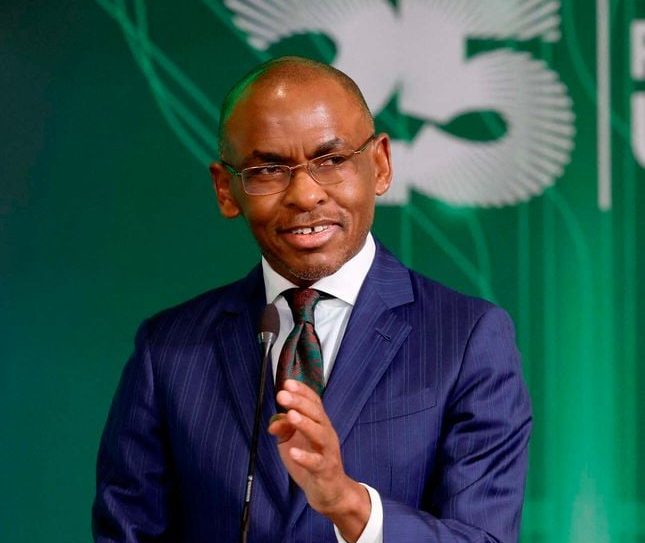
Safaricom CEO Peter Ndegwa

Kenya’s leading telecommunications giant, Safaricom, is facing mounting scrutiny after claims emerged that its board quietly extended the tenure of group CEO Peter Ndegwa without issuing any public communication, fueling outrage among shareholders, regulators, and consumer rights groups.

As of mid-April 2026, Ndegwa remains firmly in office despite his expected contract lapse on March 31, raising serious governance questions for one of East Africa’s most influential listed firms.

Governance Storm Over “Silent Extension”

The controversy stems from what critics describe as a troubling lack of transparency. Unlike previous leadership transitions, there has been no formal announcement regarding Ndegwa’s contract renewal, exit timeline, or succession plan.

Consumer lobby group Consumers Federation of Kenya has warned that the situation has devolved into “speculation and guesswork,” an unusual state for a publicly traded company of Safaricom’s stature.

“Shareholders deserve clarity. Silence on leadership succession is not just poor governance—it undermines confidence,” COFEK said in a statement.

Safaricom’s board charter reportedly caps CEO tenure at seven years, placing Ndegwa close to the upper limit, yet the company has offered no clarity on whether an extension has been formally approved.

A Sharp Departure from Past Leadership

The unfolding controversy stands in stark contrast to the transparent tenures of Ndegwa’s predecessors.

Founding CEO Michael Joseph oversaw a decade of structured growth before a clearly communicated exit in 2010, while his successor Bob Collymore had his contract extensions publicly announced in advance.

Both leaders maintained a clear governance framework that analysts say strengthened investor confidence and institutional credibility.

Ndegwa’s tenure, by comparison, is now being defined as opaque, with critics arguing that the absence of clear communication has eroded trust.

Internet Outage Sparks Lingering Questions

Public criticism intensified following the June 2024 nationwide internet outage, which coincided with Gen Z-led protests against the Finance Bill.

While Ndegwa attributed the disruption to undersea cable issues, monitoring groups disputed the explanation, noting inconsistencies in the scale and timing of the outage.

The incident drew condemnation from rights groups, including the Kenya Human Rights Commission, which later cited court orders barring internet shutdowns.

Although Ndegwa issued a public apology, the episode left lingering questions about whether external pressure may have influenced network operations.

Explosive Data Privacy Allegations

Further controversy erupted in October 2024 after investigative reports alleged that Safaricom had enabled security agencies to access customer call data records without proper judicial oversight.

The reports triggered strong reactions from civil society organizations, including Muslims for Human Rights, which accused the company of facilitating surveillance practices that could violate constitutional protections.

Safaricom denied the claims and defended its data handling practices, but tensions escalated after it reportedly withdrew advertising from Nation Media Group following the publication of the exposé.

Press freedom watchdog Reporters Without Borders criticized the move, warning of potential media intimidation.

Monopoly Concerns Resurface

Beyond governance and privacy issues, Safaricom is also under renewed scrutiny over its dominant market position.

Data from the Communications Authority of Kenya shows the company controls a majority share of mobile subscriptions and an overwhelming portion of mobile money transactions through M-Pesa.

Consumer advocates argue that such dominance stifles competition and disadvantages smaller players, calling for stricter regulatory oversight.

Ndegwa has previously dismissed such concerns, urging competitors to invest more aggressively—remarks that critics say overlook structural barriers in the market.

Rising Pressure on the Board

Despite the growing controversies, Safaricom continues to post strong financial performance, including record earnings and expansion into Ethiopia.

However, analysts warn that financial success alone may not shield the company from governance backlash.

“The issue is no longer just performance—it’s accountability,” a Nairobi-based market analyst noted. “Investors want transparency on leadership, especially in a company this critical to the economy.”

Calls for Transparency

Stakeholders are now demanding immediate action from Safaricom’s board, including:

  • Public disclosure of Ndegwa’s contract status
  • A clear succession roadmap
  • Greater transparency on governance and oversight

For many Kenyans, the board’s silence has become the central issue.

As pressure mounts, the question remains whether Safaricom will address the concerns head-on—or continue to weather a storm that is rapidly escalating into one of the most contentious corporate governance debates in the country.

Safaricom’s leadership uncertainty, combined with unresolved scandals and growing monopoly concerns, has placed the telecom giant at a crossroads, where transparency and accountability may prove just as critical as profitability.

0 comment
0 FacebookTwitterPinterestLinkedinTumblrWhatsappTelegramEmail
Safaricom

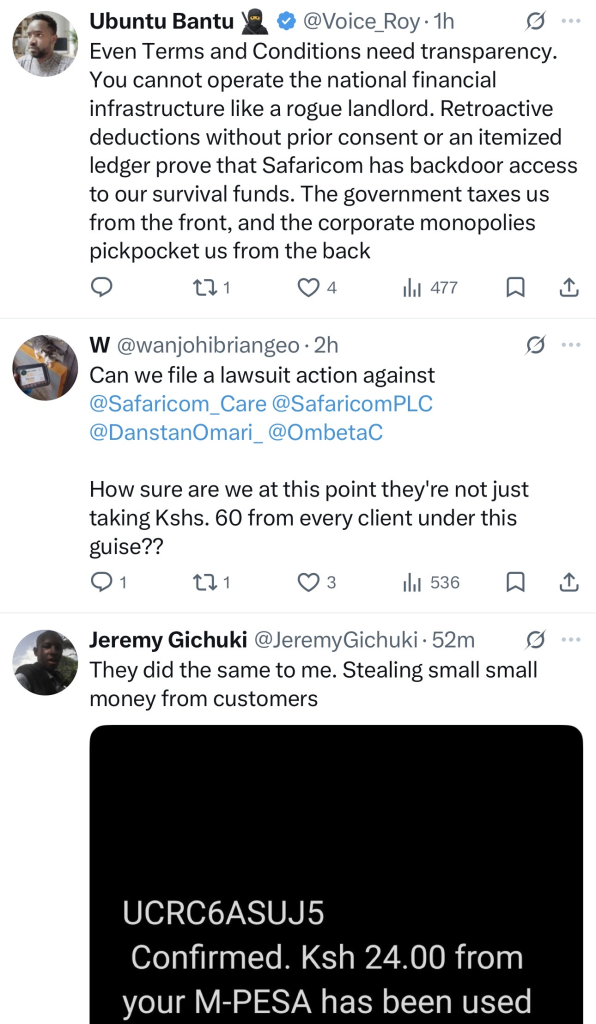
Thousands of Kenyans are raising alarm after unexplained deductions were made from their M-Pesa accounts, with telecommunications giant Safaricom PLC attributing the incident to a “system issue” linked to its Fuliza overdraft service.

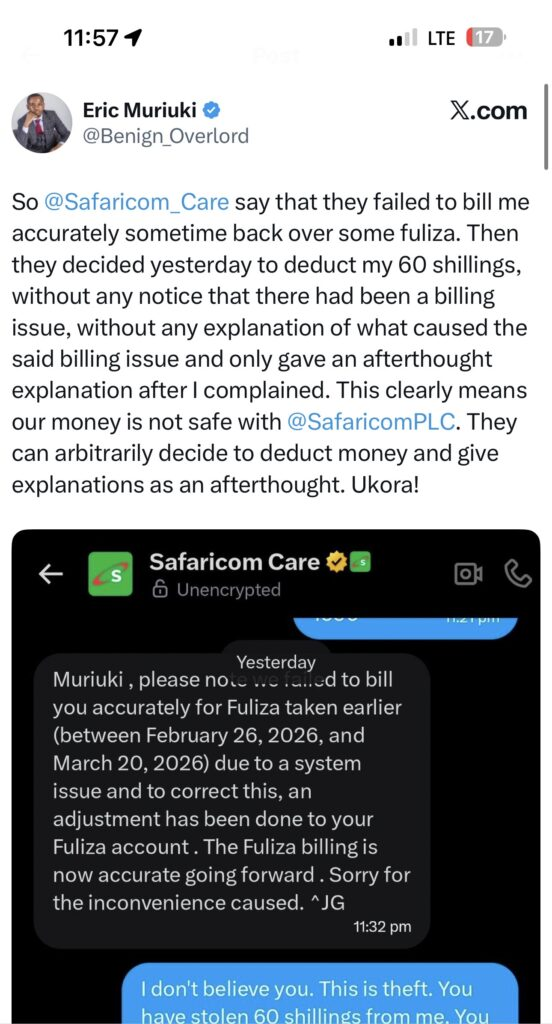
The controversy erupted over the weekend when lawyer Eric Muriuki publicly accused the company of making unauthorized withdrawals from his account. In a post on X (formerly Twitter), Muriuki shared a screenshot of his exchange with Safaricom customer care, showing the company admitting it had failed to bill him correctly for Fuliza usage between February 26 and March 20, 2026.

The correction, Safaricom said, resulted in a KSh 60 deduction from his account — applied without prior notice or a detailed breakdown.

“I don’t believe you. This is theft,” Muriuki wrote, adding that Kenyans’ money was no longer safe with the telco. His remarks quickly gained traction online, triggering a wave of similar complaints.

Flood of Customer Complaints

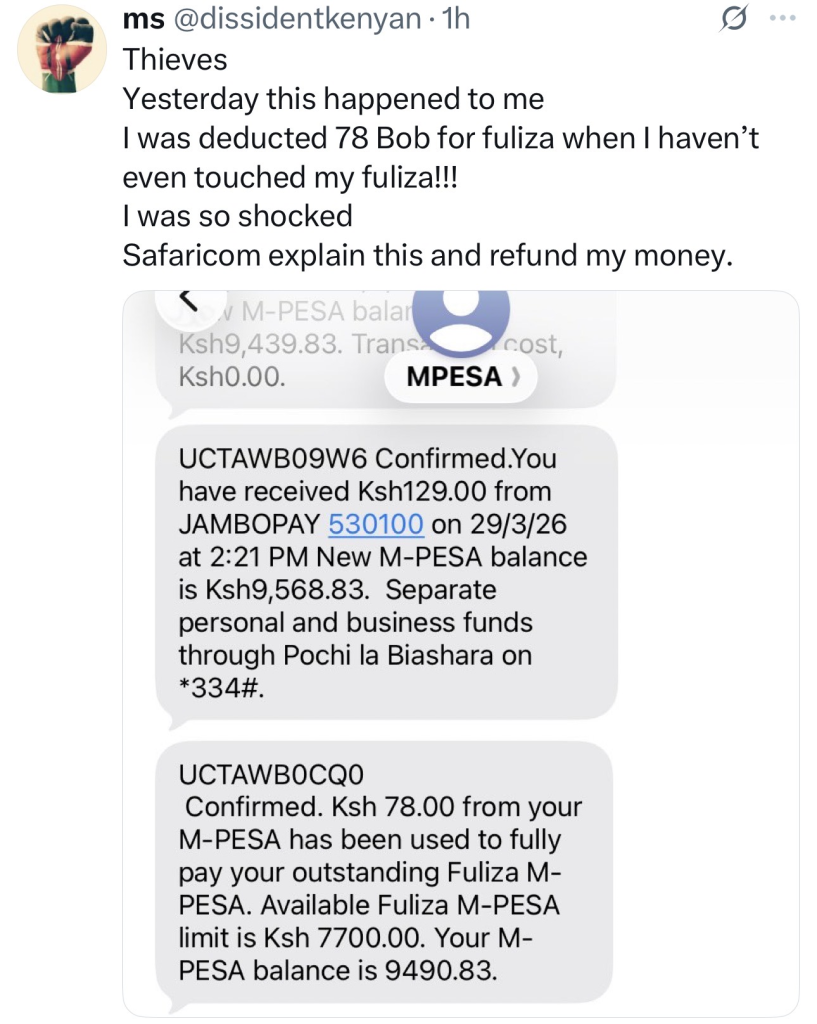
What began as a single complaint soon snowballed into a nationwide outcry. Dozens of M-Pesa users reported similar deductions, ranging from as little as KSh 27 to over KSh 1,300, all attributed to alleged Fuliza arrears within the same three-week period.

Writer and commentator Beatrice Wanjiru described the situation as “a huge scandal,” noting that some affected users claimed they had never activated Fuliza, while others insisted they had already cleared their balances.

Many users reported receiving no advance notification, only SMS alerts after the deductions had already been made. Others pointed out that the messages referenced a broad date range, making it difficult to verify specific transactions.

“They can’t even pinpoint the exact date,” one user posted, echoing a frustration shared widely across social media.

Safaricom’s Explanation Raises Questions

In response, Safaricom acknowledged a technical fault that disrupted the billing of daily Fuliza fees during the period in question. The company said it had applied a one-time “catch-up” adjustment across affected accounts and assured customers that no further deductions would follow.

However, the explanation has done little to quell public anger.

Critics have questioned why the adjustments were made without prior notice or itemised statements, and how individuals who claim never to have used Fuliza were included in the deductions.

Equally concerning is the lack of transparency. Safaricom has not disclosed the total amount recovered, the number of affected accounts, or how individual charges were calculated — leaving many to question the integrity of the process.

Pattern of Controversies

The Fuliza deductions controversy is the latest in a string of disputes involving Safaricom’s mobile money platform.

In February 2026, Nairobi businesswoman Eunice Nganga filed a constitutional petition challenging Safaricom’s policy of using erroneously sent M-Pesa funds to settle third-party Fuliza debts.

Nganga’s case stems from a 2024 incident in which she accidentally sent KSh 2,700 to the wrong number. Safaricom declined to reverse the transaction, instead applying the funds to clear the recipient’s Fuliza balance — a move she argues is unlawful. The case is currently before the High Court.

Earlier, in 2023, a class-action suit filed by three M-Pesa users accused Safaricom and its partners, including Vodafone Group, of operating Fuliza in a manner akin to unlicensed banking and mismanaging customer funds held in trust accounts. The case remains ongoing.

Bonga Points Fraud Adds to Crisis

Compounding the situation, Safaricom also confirmed reports of unauthorized Bonga Points transfers over the same weekend. Customers reported waking up to find their loyalty points depleted through transactions carried out in the early hours of the morning without their consent.

The company acknowledged “irregularities” in the system and said investigations were underway.

The coincidence of both incidents — involving the removal of customer value without authorization — has intensified scrutiny of Safaricom’s systems and internal controls.

Regulatory Pressure Mounts

The unfolding crisis has renewed calls for intervention by regulators, including the Communications Authority of Kenya and the Central Bank of Kenya.

Lawmakers have also previously expressed frustration with Safaricom’s failure to appear before parliamentary committees, particularly on issues relating to data protection and service delivery.

Analysts warn that the scale of Fuliza — which processes millions of micro-transactions daily — means even small discrepancies can translate into significant aggregate sums when applied across millions of users.

Erosion of Public Trust

For many Kenyans, M-Pesa is not just a payment platform but a financial lifeline, handling everything from rent payments to school fees and business transactions.

The latest controversy has therefore struck at the heart of public trust in one of the country’s most critical financial systems.

Consumer advocates are now urging affected users to file formal complaints with regulators, arguing that collective action may be the only way to compel accountability.

As pressure mounts, the key question remains whether Safaricom will provide full transparency on the deductions, or whether the incident will become yet another unresolved chapter in Kenya’s growing list of digital finance disputes.

0 comment
0 FacebookTwitterPinterestLinkedinTumblrWhatsappTelegramEmail
Safaricom

Safaricom is bracing for a fresh court battle after a Nairobi businessman accused the telecommunications giant of unlawfully tracking his location and sharing his private data with police, actions he says led directly to his arrest, detention, and lasting physical and psychological harm.

In a formal demand letter, businessman Alex Mutuku Mbalezi accuses Safaricom of violating his constitutional right to privacy under Article 31 of the Constitution of Kenya, 2010, and is demanding Sh250 million in compensation. The claim lands hard on the heels of a Sh200 million suit filed by acquitted Moi University student David Ooga Mokaya, signalling what could become a cascading wave of litigation against Kenya’s dominant telecom operator over alleged data protection failures.

Through his lawyer Danstan Omari, who also represents Mokaya, Mbalezi contends that Safaricom owed him both a statutory and fiduciary duty to safeguard his personal data and to ensure that any disclosure strictly complied with constitutional and legal standards. The demand letter alleges that the company unlawfully tracked and shared his location data with third parties, leading to his arrest and detention. Mbalezi says he was manhandled in custody, sustained physical injuries and has since suffered continuing health complications, psychological distress and damage to his reputation and personal dignity.

“Your actions directly facilitated the violation of our client’s fundamental rights and freedoms and exposed him to unlawful arrest,” the demand letter states.

Mbalezi is demanding that Safaricom formally admit liability within seven days and settle the Sh250 million claim. The notice warns that failure to comply within the stipulated timeframe will trigger the filing of legal proceedings without further notice.

A DISTURBING PATTERN

The businessman’s claim follows the dramatic acquittal of Mokaya on February 19, 2026, in a cybercrime case that had drawn national attention. The 24-year-old finance student was charged with publishing false information over a post on X, formerly Twitter, in November 2024. The post allegedly depicted a funeral procession with a casket draped in the Kenyan flag and made reference to President William Ruto, which prosecutors argued was intended to mislead the public into believing the Head of State had died.

During the trial before Principal Magistrate Carolyne Nyaguthii Mugo at the Milimani Chief Magistrate’s Court, evidence emerged that investigators obtained Mokaya’s phone number and location data from Safaricom following a written request by a senior police officer on November 14, 2024. Daniel Hamisi, a Safaricom security department employee who testified as a prosecution witness, confirmed under cross-examination that the information was released without a court order being presented.

Mokaya was arrested the following day in Eldoret. His Samsung phone, laptop and identification card were seized before a search warrant was obtained. In acquitting him, the court ruled that the accused person’s gadgets were seized unlawfully and were subjected to forensic examination without any judicial authorisation. The magistrate found that the prosecution had failed to conclusively link Mokaya to the disputed post and that key digital evidence had been obtained in breach of the law.

“Your personal data, your messages, your contacts, and your location are part of your dignity and privacy. These rights were violated,” Omari said following the acquittal, announcing plans to file a constitutional petition at the High Court’s Constitutional and Human Rights Division.

SAFARICOM DIGS IN

In a letter dated February 24, 2026, Safaricom rejected Mokaya’s demand outright. Legal services head of department Wangechi Gichuki stated that having reviewed the February 19 judgment, “Safaricom does not admit, and expressly denies, any liability as alleged.” Gichuki added that the trial court made no binding determination of civil liability against Safaricom.

The company argued that observations in the judgment concerning investigative practices cannot be construed as imposing strict constitutional liability on a telecommunications provider acting in compliance with formal requests from law enforcement agencies, and warned that any litigation will be vigorously and robustly defended.

Safaricom has consistently maintained that it releases customer information only when required by law or pursuant to a court order. Its published privacy policy underscores compliance with legal requirements and international privacy management standards. Omari, however, insists that testimony from the company’s own employee amounts to damning evidence of systemic non-compliance.

A TROUBLED RECORD ON DATA PROTECTION

The twin claims thrust Safaricom, Kenya’s dominant telecom operator with more than 40 million subscribers, back into the spotlight over data protection. This is not the first time the company has faced such allegations.

In October 2025, the Business Daily reported that Safaricom had failed to settle a suit in which it sought to block the sale or transfer of stolen personal data belonging to 11.5 million subscribers. Court documents showed that two former senior managers at Safaricom allegedly accessed and shared data, including customer names, phone numbers, birth dates, location records, gambling histories, passport and identity card numbers, with a businessman for onward sale to a top sports betting firm.

That data leak triggered multiple legal actions, including a constitutional petition seeking Sh100 million for the alleged primary victim and Sh10 million for each of the 11.5 million subscribers who joined the data theft suit. The scheme allegedly began with the former managers creating an algorithm to collate and analyse subscriber betting patterns. They amassed personal data on 11.5 million subscribers, which was then transferred from Safaricom servers to password-protected Google drives that the company has been unable to access.

Safaricom warned the court that the data could be transferred to additional third parties. “The plaintiff has not been able to secure the personal laptops owned by the 2nd and 3rd defendants, which then allows them to disseminate the subscriber data,” the company told the court. “They will disclose the confidential information of millions of subscribers, thus exposing Safaricom to numerous lawsuits.”

THE REGULATORY LANDSCAPE

The Data Protection Act, 2019, was enacted to afford Kenyans broader rights over how their personal information is handled. Article 31 of the Constitution guarantees the right to privacy, including the right not to have information relating to family or private affairs unnecessarily required or revealed and the right not to have communications unlawfully intercepted.

In December 2023, the Office of the Data Protection Commissioner adopted a guidance note for the communications sector, assisting service providers in telecommunications, broadcasting and postal services to comply with the Data Protection Act. The guidance outlines principles for the lawful processing of personal data, including requirements for consent, contractual necessity or compliance with a legal obligation as the basis for any data sharing.

Data Protection Commissioner Immaculate Kassait has previously called on the sector to adhere strictly to data protection principles, raising particular concerns about data collection and tracking, the misuse of personal data and surveillance by telecommunications companies.

Legal analysts note that while the Data Protection Act permits limited disclosures to law enforcement for legitimate investigations, court precedents have increasingly demanded judicial oversight, particularly where real-time location data is at stake. In a landmark ruling in April 2024, the High Court declared the mandatory collection of International Mobile Equipment Identity numbers by mobile network operators unconstitutional, affirming the primacy of privacy, data protection and freedom from unreasonable surveillance in Kenya’s digital ecosystem.

A PRECEDENT-SETTING MOMENT

Omari has described the Mokaya case as a landmark moment for digital rights in Kenya. He has signalled the possibility of a sweeping class action that could run into trillions of shillings if the millions of subscribers potentially affected come forward.

“This is not just about David Mokaya. It is about restoring sanity to the telecommunications sector. Every Kenyan whose privacy has been violated in this manner now has a justiciable claim,” Omari said.

The case raises wider questions about the relationship between telecommunications companies and law enforcement agencies. During the Mokaya trial, the arresting officer admitted he had no court order to carry out the search or seize Mokaya’s phone and laptop. The court emphasised that cybercrime investigations must strictly comply with legal procedures, noting that digital evidence is highly sensitive and must be obtained through lawful means.

Mokaya himself has described months of gruelling travel between Eldoret and Nairobi to attend court appearances, funded by well-wishers and family members who also struggled to pay his tuition fees. “I used to travel all the way from Eldoret where I stay and study to come attend mentions and hearings and travel back to Eldoret on the same day due to financial difficulties,” he said in his supporting affidavit. Omari has alleged that Mokaya “can’t even talk due to mental trauma and shock that gripped him since he was charged.”

WHAT LIES AHEAD

The dispute is expected to raise far-reaching questions about data protection, privacy rights and the legal obligations of telecommunications companies handling subscriber information under Kenyan law. Mokaya’s lawyers are expected to seek conservatory orders to restrain any further release of subscriber data without a court sanction. The High Court’s determination could set a decisive precedent governing how telecom operators balance cooperation with security agencies against the constitutional right to privacy in Kenya’s fast-evolving digital landscape.

With Mbalezi’s claim adding fresh pressure, Safaricom now finds itself fighting on two fronts against allegations that strike at the heart of its relationship with millions of Kenyans who entrust the company with their most sensitive personal information. The company had not issued a public statement on the Mokaya matter by Tuesday afternoon, nor had it responded to Mbalezi’s demand letter.

As the seven-day ultimatum in Mbalezi’s notice ticks down, all eyes are on Safaricom’s next move and on the High Court, which may soon be called upon to define the boundaries of digital privacy in Kenya for generations to come.

0 comment
0 FacebookTwitterPinterestLinkedinTumblrWhatsappTelegramEmail
Vodacom Safaricom share deal

A fresh storm is brewing over a controversial Sh244 billion plan to offload the government’s stake in Safaricom PLC, with critics now accusing South Africa’s Vodacom Group of complicity in what they describe as a questionable restructuring that could alter control of Kenya’s most valuable company.

The unfolding row has triggered political, legal, and economic debate, with opponents warning that the proposed transaction could shift influence over Safaricom, and by extension its flagship mobile money platform M-Pesa, without sufficient public scrutiny.

Allegations and Political Pushback

The controversy centers on claims that a structured share transaction, reportedly valued at Sh244 billion, could dilute the government’s influence in Safaricom while strengthening Vodacom’s effective control.

Critics argue that although the deal is being framed as a financial restructuring or capital optimization strategy, its long-term implications could affect decision-making authority, dividend flows, and oversight of sensitive telecommunications infrastructure.

In a social media post on February 24, 2026, veteran journalist Tony Gachoka did not mince words: “VODACOM ENGLISH COMPANY BEING USED BY WILLIAM RUTO TO STEAL BILLIONS OF SHILLINGS FROM KENYANS, IN A SECRET DEAL WORTH 200 BILLION HAS PANICKED.” That, in a single capitalised declaration, is the Gachoka doctrine: a South African-registered, London-parentage corporate vehicle is being weaponised to siphon the birthright of ordinary Kenyans — and President William Ruto is holding the door open.

Gachoka has since filed a constitutional petition at the Milimani High Court alongside economics professor Fredrick Onyango Ogola, naming as respondents the Cabinet Secretaries for the National Treasury and for ICT, the Communications Authority, the Competition Authority, the Attorney General, Safaricom PLC itself, and Vodacom Group. The petition is a grenade rolled into the gilded machinery of Kenya’s biggest privatisation in a generation.

The Gachoka- lawyer Steve Ogola petition, filed at the Constitutional and Human Rights Division of the High Court in January 2026, reads less like a legal pleading and more like an indictment. Its central allegations are as follows:

Gross undervaluation: The petitioners contend that the KSh 34 price is a gross misrepresentation of Safaricom’s worth. Independent economic analysis places the shares’ intrinsic value at between KSh 70 and KSh 80 per share — a differential that, extrapolated across the 6 billion shares being sold, translates into a potential loss to the Kenyan public of over KSh 250 billion. The petition argues this price was “poorly and selectively negotiated by the respondents to the grave detriment of the Kenyan public.”

Opaque, non-competitive process: The sale was structured as a negotiated block trade with a single buyer — Vodacom — with no public tender, no competitive bids solicited, no disclosure of who advised the government, and no evidence that alternative buyers or structures were considered. The petition describes the process as “rushed, opaque, non-competitive and procedurally dubious.”

Constitutional violations: The petition invokes Articles 1, 10, and 227 of the Constitution — the pillars of public participation, national values, and transparency in the disposal of public property. The petitioners argue the Public Procurement and Asset Disposal Act, 2015 was bypassed, that the Privatisation Act, 2025 was not properly observed, and that Parliament’s role was reduced to a statutory rubber stamp — a 28-day window within which lawmakers must act or the deal proceeds automatically by March 26, 2026.

National security and sovereignty: Perhaps the most explosive allegation involves what Safaricom actually is — not merely a telecom company but a data sovereign, a financial artery, and a national security infrastructure. M-Pesa alone processes over 100 million transactions daily, services 38 million Kenyan customers, and forms the backbone of Kenya’s digital financial inclusion story. The petition argues that handing Vodacom 55 percent control would “irreversibly undermine Kenya’s strategic leverage over critical data infrastructure, mobile money systems and national security interests.”

On February 24, 2026 — the same day Gachoka published his explosive social media broadside — The Standard reported that Vodacom Group had filed a formal application before High Court Judge Lawrence Mugambi, asking to be struck out entirely as a respondent. The company’s argument: it is not a party to the government’s shareholding decision and exercises no control over it.

Safaricom PLC has taken a similar position, telling the court it is not the proper respondent as shareholding decisions rest with the government. Both companies, in effect, are pointing the finger at State House and the National Treasury — and asking the court to let them watch from the sidelines.

For Gachoka, this is precisely the tell. In his social media post, he claimed Vodacom was “trying to pull out“ and attributed this to fears of being linked to the kind of corruption scandals that have followed UK-connected corporate deals in Kenya’s recent past. Whether or not the legal manoeuvre amounts to a retreat under fire — or merely a legitimate procedural point — it has given Gachoka fresh ammunition to fire across every social media platform available to him.

Government’s Position

The National Treasury has previously defended proposals to restructure or divest certain state assets as part of a broader fiscal consolidation strategy aimed at easing public debt pressure and raising capital for development priorities.

Officials maintain that any transaction involving Safaricom would comply with the Capital Markets Authority (CMA) regulations, Nairobi Securities Exchange listing rules, and shareholder approval requirements.

However, critics insist that transparency must go beyond regulatory minimums given Safaricom’s central role in Kenya’s economy.

Vodacom’s Role Under Scrutiny

Vodacom, which already holds a significant stake in Safaricom alongside the Government of Kenya and public shareholders, has now been drawn into the controversy.

Accusers claim that the structure of the proposed transaction could disproportionately benefit Vodacom, potentially consolidating its strategic leverage over Safaricom’s operations and cross-border M-Pesa expansion.

Neither Safaricom nor Vodacom had publicly admitted wrongdoing at the time of publication. Insiders within corporate circles describe the accusations as politically charged and lacking documentary proof.

Market analysts caution that public rhetoric could unsettle investor confidence if not addressed promptly and clearly.

Market Reaction and Investor Concerns

Safaricom is one of the largest counters on the Nairobi Securities Exchange, with millions of Kenyans holding shares directly or indirectly through pension funds and investment schemes.

Any perception of governance instability could trigger volatility in the stock, analysts warn.

“Investors are watching closely. The issue isn’t just control — it’s predictability and regulatory certainty,” said a Nairobi-based investment advisor.

The company’s dominance in mobile money, connectivity, and enterprise solutions makes it a cornerstone of Kenya’s digital infrastructure. As such, changes in ownership dynamics carry broader economic implications.

Legal and Regulatory Outlook

Lawyers familiar with capital markets law note that allegations of “complicity” would require substantial evidence to sustain any formal legal challenge. For now, the dispute appears to be unfolding in the court of public opinion rather than in a courtroom.

Still, petitions or injunction applications cannot be ruled out if political pressure intensifies.

What Next?

The controversy comes at a time when the government is under pressure to manage public debt while preserving strategic national assets.

With Safaricom’s dividends forming a significant revenue stream for the state, the political sensitivity of the Sh244 billion figure is unlikely to fade quickly.

As calls for disclosure grow louder, the key question remains whether the proposed share deal represents a prudent fiscal strategy — or a restructuring that could permanently reshape control of Kenya’s digital giant.

For now, the accusations against Vodacom remain claims awaiting substantiation, but the political and market tremors they have sparked are already being felt across Kenya’s corporate and financial landscape.

0 comment
0 FacebookTwitterPinterestLinkedinTumblrWhatsappTelegramEmail
Safaricom

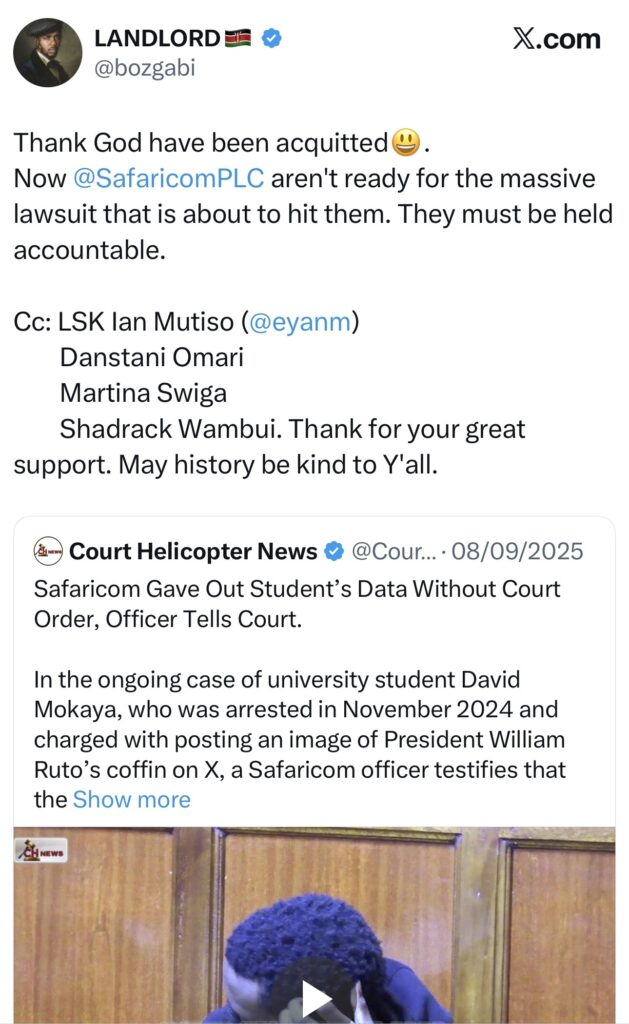
The acquittal of Moi University student David Mokaya by the Milimani Law Courts has opened a legal Pandora’s box that threatens to embarrass both Kenya’s dominant telecommunications company and the Directorate of Criminal Investigations in equal measure, as the young man’s lawyers announced plans to pursue the State for malicious prosecution while the court itself placed Safaricom on notice over what it described as a blatant and illegal breach of a subscriber’s constitutional rights.

Magistrate Caroyne Mugo, in a ruling delivered on February 19, 2026, did not merely acquit Mokaya of charges that he published false information about President William Ruto.

She went further, pointedly flagging Safaricom as a company with serious questions to answer after it emerged during trial that the telecommunications giant had surrendered Mokaya’s private subscriber data to police investigators without any court order authorising the disclosure.

The magistrate’s remarks were not obiter.

They were deliberate, targeted and carry the weight of judicial censure that Safaricom’s legal and regulatory affairs teams will find impossible to ignore.

David Mokaya outside Milimani Courts after being acquitted.

The facts of the case, as they emerged during weeks of testimony, paint a disturbing picture of a security apparatus that moved with remarkable speed and remarkable disregard for constitutional safeguards once a social media post touching on the President’s name entered the system.

On November 13, 2024, a post appeared on platform X under the username “Landlord @bozgabi” depicting a funeral procession with a military escort carrying a casket draped in the Kenyan flag, accompanied by a caption that investigators said referenced President Ruto.

Within twenty-four hours, a senior police officer identified in court as Michael K. Sang had written directly to Safaricom demanding the subscriber details behind the account.

By November 15, a team of detectives from the Serious Crimes Unit had descended on Eldoret, tracked Mokaya to an area opposite Moi University’s Annex, and arrested him.

A Samsung phone, a laptop and his identity card were seized before anyone had troubled themselves to obtain a search warrant.

It was Chief Inspector Bosco Kisau who delivered the most damaging admissions from the prosecution’s own witness stand.

Under cross-examination by defence lawyers Danstan Omari, Ian Mutiso and Shadrack Wambui, Kisau conceded that he had not been served with a court order authorising the investigation of Mokaya’s devices. He admitted he was unaware of a High Court ruling requiring law enforcement to obtain judicial authority before compelling mobile service providers to release subscriber details.

He further admitted that he could not confirm the origin, source or geographic location of the disputed post.

He could not confirm whether the SIM card linked to the account had been properly registered. He had not recorded a statement from the complainant, President Ruto.

And crucially, when pressed directly, he conceded that the post in question did not actually contain a photograph of the President.

Safaricom employee Daniel Hamisi, who also took the stand, confirmed that he had released Mokaya’s details upon a written request from a senior police officer, without any court order having been presented or demanded.

His testimony crystallised what civil liberties advocates have long argued: that Kenya’s Data Protection Act of 2019 and the constitutional right to privacy exist on paper in a manner that is, in practice, subordinate to a phone call or a letter bearing a senior officer’s signature when matters touching on political figures are involved.

The magistrate was unsparing.

She found that police had failed miserably in their duty, that the accused had been framed, and that no direct evidence linked Mokaya to the alleged offence.

She noted that Mokaya’s social media account was shared with three other individuals who were never traced or called as witnesses, creating reasonable doubt that could not be resolved by the prosecution’s threadbare evidence.

She noted that the alleged offence was said to have been committed in Nairobi while Mokaya was physically in Eldoret.

She noted the complete absence of forensic or digital evidence tying him to the post. She observed that the court could not rule out the possibility that the post itself had been fabricated and planted on an account associated with his name.

She also noted something that ought to concern the leadership of the Safaricom corporation and its board.

The company’s compliance with an unlawful police request, without demanding judicial authorisation, may constitute a violation of the Data Protection Act.

That legislation imposes clear obligations on data controllers and processors regarding the circumstances under which personal data may be disclosed to third parties, including law enforcement.

Disclosure without a court order, in circumstances where one is legally required, is not a procedural technicality.

It is a substantive breach carrying potential regulatory consequences from the Office of the Data Protection Commissioner and civil liability in the courts.

Omari and Mutiso, who led Mokaya’s defence and who are no strangers to high-profile constitutional litigation, wasted no time in signalling what comes next.

They told the court after the ruling that they intend to sue the State for malicious prosecution. Legal analysts familiar with their track record consider this not an idle threat but a certainty.

A malicious prosecution claim would require establishing that the prosecution was initiated without reasonable and probable cause, that it was actuated by malice, and that it terminated in the accused’s favour. On the facts as found by the magistrate, all three elements appear to be richly available.

The civil suit, when filed, will almost certainly name Safaricom as a defendant or at minimum as a party from whom discovery is sought.

The company will need to account for its internal processes around law enforcement data requests. It will need to explain why its compliance team released subscriber data without demanding what the law requires.

It will need to address whether this was an isolated incident or systemic practice. These are questions that Safaricom’s corporate communications machinery cannot deflect with a press statement.

For Mokaya himself, the personal cost of this ordeal is not easily quantified.

He was charged on November 13, 2024, and the case dragged through a full trial over a period of roughly three months.

His lawyer told the court that the student could not even speak in the immediate aftermath of the ruling due to mental trauma and shock that had gripped him since his arrest.

He spent the duration of the case on a bond of one hundred thousand shillings or a cash bail of fifty thousand shillings, money that a finance student at a public university would not easily produce. His devices were confiscated. His movements were constrained. His studies were disrupted.

The broader significance of this case extends well beyond one young man’s acquittal.

It arrives at a moment when the relationship between digital speech, state power and telecommunications infrastructure is under intense scrutiny across Africa.

Kenya’s Data Protection Act was celebrated when it passed as a significant step toward aligning the country with international data protection standards.

The Mokaya case suggests that the legislation’s practical force remains weak in the face of political pressure and institutional habit.

When a senior police officer can write a letter to a telecommunications company on a Tuesday and have subscriber location data by Wednesday morning without a magistrate or judge having been involved at any point, the statute’s protections are nominal at best.

The Law Society of Kenya, through Mutiso’s involvement in the case, has effectively placed its institutional weight behind the argument that telecom companies must resist unlawful data requests regardless of who is making them and regardless of whose name appears in the underlying social media post.

That argument will now be tested in the civil courts, where Mokaya’s lawyers say they will press it with full force.

Safaricom has not issued a public statement on the matter at the time of publication.

The company, which controls the overwhelming majority of Kenya’s mobile subscriber market and whose M-Pesa platform is embedded in the economic life of tens of millions of Kenyans, has significant reputational exposure if the civil litigation proceeds and produces further uncomfortable disclosures about the ease with which law enforcement has historically been able to extract personal data from its systems.

The magistrate reminded police, in terms that deserve to be read widely, that the duty to observe the law does not diminish because the name of the President or any other powerful figure appears in a social media post.

She reminded them that cases of this nature must be handled with caution and free from public or political pressure.

She reminded them that the criminal procedure code and the Constitution are not suspended when someone posts something uncomfortable about a head of state.

For a twenty-four-year-old finance student from Moi University who spent months answering charges that a court ultimately found may have been built on a fabricated foundation, those reminders came at significant personal cost.

The question that will now occupy Kenya’s legal community is whether the institutions that failed him will be made to pay one.

0 comment
0 FacebookTwitterPinterestLinkedinTumblrWhatsappTelegramEmail
Safaricom MPESA shop

Safaricom has moved to clarify how the Social Health Authority (SHA) can deduct money from M-PESA accounts without prompting users to enter their PIN, following public concern over automatic deductions linked to the Lipa Mdogo Mdogo health insurance service.

The clarification came after an M-PESA user took to social media on Monday, January 12, 2026, questioning how funds were being withdrawn from his account without his direct authorization at the time of payment.

SHA fraud
SHA building

The user, identified on X as @UCollince, said the deductions began shortly after he enrolled in SHA’s Lipa Mdogo Mdogo contribution plan.

“Good morning @SafaricomPLC. Kindly explain how @_shakenya is able to deduct money from our M-PESA accounts without prompting us to enter our PIN. This started happening after we registered for the Lipa Mdogo Mdogo service. We need clarification on how this authorization works,” he wrote.

The post quickly gained traction online, with many Kenyans expressing unease over what they perceived as silent deductions from their mobile wallets, raising broader questions about consent, transparency, and data security.

Safaricom Responds

In response, Safaricom explained that the deductions occur when a customer has activated M-PESA Ratiba, the telco’s standing order feature, and has granted SHA permission to auto-deduct contributions.

“Hello Collince, apologies for that. If you have activated M-PESA Ratiba, which is a standing order service on M-PESA, and enabled SHA to auto-deduct, this can happen without prompting for the PIN,” Safaricom stated.

However, the user disputed Safaricom’s explanation, arguing that his mother never activated M-PESA Ratiba, yet her money was being deducted without her authorization.

Safaricom did not respond to that concern.

According to the telco, once a user authorises a standing order, future payments can be processed automatically without requiring repeated PIN confirmation.

What Is M-PESA Ratiba?

M-PESA Ratiba was introduced in October 2024 as a first-of-its-kind mobile money feature allowing users to set up recurring payments directly from their M-PESA wallets.

The service enables automatic transfers on a daily, weekly, monthly, or yearly basis, making it ideal for recurring obligations such as rent, school fees, insurance premiums, subscriptions, utility bills, and now health insurance contributions.

Safaricom says the feature is designed to simplify payments and improve consistency, with no penalties for failed or cancelled standing orders due to insufficient balance.

Public Concerns Persist

Despite the explanation, the incident has reignited debate over consumer awareness and digital consent, with some users arguing that many Kenyans may not fully understand the implications of activating auto-deduction services.

Consumer rights advocates are now calling for clearer communication, stronger opt-in notifications, and easier ways for users to monitor and cancel standing orders.

As SHA ramps up enrolment into its health financing programs and M-PESA continues to anchor Kenya’s digital payments ecosystem, the episode underscores the growing tension between convenience and control in mobile money transactions.

For now, Safaricom is urging users to review their M-PESA Ratiba settings and confirm which organisations have permission to auto-deduct funds from their wallets.

0 comment
0 FacebookTwitterPinterestLinkedinTumblrWhatsappTelegramEmail
Safaricom CEO Peter Ndegwa

Nearly one in every four Safaricom customers believes the telecommunications giant is shortchanging them on data and text message charges, a damning regulatory survey has revealed, exposing a crisis of trust at Kenya’s dominant mobile operator just as mobile data becomes its biggest money spinner.

The explosive findings from the Communications Authority of Kenya paint a troubling picture of widespread consumer suspicion, with only 77 per cent of Safaricom’s massive customer base trusting their data bills and 77.7 per cent believing they are accurately charged for SMS services. This means a staggering 23 per cent of subscribers, millions of Kenyans, harbour deep doubts about whether they are getting what they pay for.

The timing could not be worse for Safaricom. The company just recorded a historic milestone in its half-year results to September 2025, with mobile data revenue surging 18 per cent to Sh44.4 billion, overtaking voice revenue for the first time in the telco’s history. Voice, once the backbone of telecommunications, managed only a paltry 0.5 per cent growth to Sh41.09 billion, highlighting how critical data has become to the company’s bottom line.

But as Safaricom celebrates this financial triumph, the regulatory survey commissioned by the Communications Authority and conducted by Strategic Synergy Consultants between July 2024 and June 2025 exposes an uncomfortable truth: customers do not trust how they are being billed for the very services now driving the company’s profits.

“Safaricom shows lower performance compared to other providers. While still a majority, these lower figures indicate that Safaricom customers are less confident in billing accuracy, particularly for data services,” the report states with clinical precision.

The contrast with competitors is stark and humiliating. Jamii Telecommunications, a relative minnow in the market, enjoys the highest trust ratings, with 98.4 percent of customers confident in their data billing and 88.6 percent trusting SMS charges. Airtel Kenya follows closely with 98.3 percent and 86.2 percent respectively. Even Telkom Kenya, long struggling for market relevance, outperforms Safaricom on billing credibility.

The mistrust extends beyond data and texts. Only 80.2 percent of Safaricom customers believe they are correctly charged for voice calls, the lowest rating among all operators. By comparison, a remarkable 97.6 percent of Airtel customers trust their call billing, followed by Jamii at 96.7 percent and Telkom at 94 percent.

The survey, which covered more than 4,200 respondents, lays bare a fundamental problem: transparency. A paltry 18 percent of Safaricom customers say they receive monthly billing information, compared with 44.1 percent of Airtel subscribers and 35 percent of Jamii customers. Without regular, detailed billing statements, customers are left guessing whether the charges deducted from their accounts match the services consumed.

This opacity becomes especially problematic in an era when data consumption is exploding. Increased online learning, remote working and entertainment streaming have made data services indispensable, transforming mobile internet from a luxury into a necessity. Kenyans are using more data than ever before, making billing accuracy not just a consumer rights issue but a question of economic justice.

The survey notes that billing disputes consistently rank among the most common complaints lodged by subscribers with the Communications Authority, according to quarterly regulatory reports. This suggests the problem is not merely perception but reflects real, ongoing frustrations with how charges are calculated and applied.

Safaricom’s dominance in the market makes the trust deficit even more significant. The company controls approximately 65 percent of Kenya’s mobile subscriptions as of September last year, dwarfing Airtel’s 30.7 percent market share. Telkom and Jamii each hold about one percent. With such overwhelming market power, Safaricom effectively holds millions of Kenyans captive, unable to easily switch to competitors even when dissatisfied.

The billing trust crisis comes on the heels of other controversies that have dented Safaricom’s reputation. In late 2025, the company faced fierce public backlash after quietly slashing data allocations on its popular ‘No Expiry’ bundles by more than half, effectively doubling internet costs overnight. Customers who had been getting 255 megabytes of non-expiring data for Sh51 suddenly found themselves receiving only 102 megabytes for the same price.

Safaricom initially blamed the cuts on a technical issue, an explanation many customers found unconvincing given the changes persisted for over a week before the company restored original allocations under intense pressure. The incident reinforced suspicions that the telco was testing how much it could squeeze from customers before provoking rebellion.

Industry analysts note that billing transparency is fundamental to maintaining consumer trust in any service sector, but especially in telecommunications where complex tariff structures, data throttling and variable network quality create information asymmetries that favor providers over customers. When the dominant player in the market performs worst on transparency metrics, it raises questions about whether market power has bred complacency.

The Communications Authority report pointedly observes that improved billing transparency and clarity are key to sustaining consumer trust across all providers. For Safaricom, this is not merely a regulatory box-ticking exercise but an existential challenge as the company transitions from voice to data as its primary revenue engine.

The company’s response to these findings will be closely watched. Will Safaricom dismiss the survey results as statistical noise, or will it acknowledge that nearly a quarter of its customers, millions of Kenyans, feel they cannot trust the bills they receive? The answer will determine whether this trust deficit deepens into a full-blown crisis of confidence that competitors could exploit.

Rivals have already been circling, banking on lower call tariffs and aggressive data promotions to chip away at Safaricom’s dominance. Airtel has repeatedly positioned itself as the more customer-friendly alternative, offering better value data bundles and, according to this survey, significantly higher billing credibility. The trust gap revealed by the regulatory study hands ammunition to these competitors.

For ordinary Kenyans, the survey findings validate what many have long suspected: that the charges appearing on their mobile accounts do not always add up, that data bundles seem to deplete faster than usage would suggest, and that the dominant telco’s billing practices merit serious scrutiny.

As mobile data cements its position as Safaricom’s biggest revenue line, the company faces a moment of reckoning. Trust, once lost, is notoriously difficult to rebuild. With nearly a quarter of customers already doubting billing accuracy, Safaricom must act decisively to restore confidence or risk watching its hard-won market dominance slowly erode under the weight of consumer suspicion.

The Communications Authority has thrown down the gauntlet. The question now is whether Safaricom has the will to pick it up.

0 comment
0 FacebookTwitterPinterestLinkedinTumblrWhatsappTelegramEmail
Kenyan money

A storm is brewing at SIC Investment Co-operative as its chief executive officer, Churchill Winstones, has abandoned ship, leaving behind thousands of anxious depositors struggling to recover their hard-earned savings from the troubled society.

Winstones’ dramatic exit late last week comes as the once-popular Sacco, which counts current and former Safaricom employees among its 5,300 members, battles a crippling cash crunch that has left investors who sunk millions into its Pepea Fixed Deposit product stranded.

The departure marks yet another shake-up at the beleaguered institution, which in June witnessed the entire board being shown the door and replaced with interim directors who were only confirmed three months later. Winstones becomes the second CEO to flee the cooperative in less than four years, following Sarah Wahogo who served from March 2022 until early last year.

Multiple investors who each deposited at least Sh4 million into the Pepea Fixed Deposit account have told this writer that SIC has been playing a dangerous game of delay tactics, repeatedly postponing payments and citing liquidity problems as their investments reach maturity.

The scale of the crisis is laid bare in the cooperative’s annual report for 2024, which reveals a shocking Sh380 million bank run on the Pepea product as panicked customers rushed to pull out their money earlier than expected. The unexpected mass withdrawal has created a domino effect, leaving those who dutifully held their investments to maturity unable to access their funds.

Acting CEO Jared Odhiambo, who previously served as head of finance, has admitted the society is drowning in liquidity challenges but insists they have a plan to settle all investors by March next year. He claims the cooperative is gradually paying off depositors and is now restructuring the product to tie it to specific projects.

However, such assurances ring hollow for investors who were promised their principal and accrued interest within 10 days of maturity. Some have already written to the Commissioner for Co-operatives Development, David Obonyo, desperate letters seen by this publication that paint a picture of growing desperation.

The Pepea Fixed Deposit, which SIC marketed as an exclusive product offering lucrative returns of up to 12 percent annually, attracted depositors with promises of competitive rates second to none in the market. Investors who locked in amounts exceeding Sh3 million for 12 months were promised returns of 12 percent, significantly higher than what most banks offer.

The minimum investment of Sh50,000 could be locked in for six to 12 months, with returns ranging from 10 percent to 12 percent depending on the amount deposited and tenure selected. The product came with a harsh penalty clause, investors who withdrew before maturity forfeited all accrued interest, a trap that has now left many feeling cornered.

Adding to the mess, SIC was forced to restate its books for the year ended December 2023 to correct several misstatements, slashing retained earnings by Sh26.15 million. The accounting irregularities raise troubling questions about the financial management and oversight at the cooperative.

Interest payments on the Pepea product climbed to Sh48.95 million in 2024 from Sh40.35 million the previous year, indicating the product’s growing popularity just before the crisis hit. What triggered the sudden rush by many customers to withdraw their funds early remains unclear, but the consequences have been devastating for those who played by the rules.

The Commissioner for Co-operatives claims he was unaware of the liquidity crisis despite letters from distressed investors landing on his desk. Obonyo has now promised to intervene, but for many depositors watching their savings disappear into a black hole, such promises offer little comfort.

SIC Investment Co-operative, which started operations in 2009, built its reputation partly on its association with telecommunications giant Safaricom, attracting employees and former staff who trusted the society with their retirement savings and investment funds. The principal activities include real estate investment, marketable securities and private equity.

0 comment
0 FacebookTwitterPinterestLinkedinTumblrWhatsappTelegramEmail
Safaricom

A silent but extremely significant power shift is unfolding inside Safaricom, and most Kenyans have not yet understood its full impact.

The public announcement issued on December 3 appears technical and routine, but buried in the text is a restructuring that could permanently alter who controls Sub Saharan Africa’s most profitable company. If Parliament, the courts and the public do not intervene, another major legal battle is almost guaranteed.

Vodafone Kenya Limited is buying 15 percent of Safaricom from the Government of Kenya at KSh 34 per share, a massive KSh 204.3 billion transaction. At the same time, Vodacom Group will increase its ownership of Vodafone Kenya to 100 percent, gaining an additional 4.99 percent indirect stake in Safaricom. When the dust settles, Vodafone Kenya which is fully owned by Vodacom Group will control 55 percent of Safaricom. That is a controlling majority. That is veto power. That is strategic dominance over Kenya’s largest taxpayer and the backbone of the financial technology ecosystem. Once that level of control is established, reversing it becomes almost impossible.

Meanwhile, the Government of Kenya drops from 35 percent to 20 percent. This means the State is no longer the strongest counterweight to foreign interests within the company. Public institutions such as NSSF also lose strategic leverage. The new reality is that a foreign entity will hold more voting power, more influence over the board and more authority over long term strategic decisions. Whether intended or not Kenya has effectively given up real control of its most important digital infrastructure company.

Even more concerning is the dividend buyout clause. Vodafone will pay KSh 40.2 billion upfront to acquire the rights to future Safaricom dividends that would have been paid to the Government. The Treasury gets quick cash today but loses steady long term revenue for years ahead. It is the kind of short term relief that appeals to a cash stressed government but it weakens the country’s fiscal position in the future. This is how countries slowly lose economic sovereignty. Not at once, but one desperate financial year at a time.

This raises a political question that cannot be ignored. Why sell such a large stake now Why at a premium Who gains the most from this timing The offer price of KSh 34 which is 21 percent above the market price proves that Vodafone is acquiring control not merely increasing an investment. No rational investor pays that kind of premium unless strategic dominance is the target. At a time when Safaricom shares have surged 96 percent this year why is the Government giving away long term revenue for one off payments Why is a national digital backbone being treated as an ordinary commercial asset These are questions that will not only stir public outrage but also fuel litigation and heavy debate in Parliament.

Vodafone Kenya claims it does not intend to take over Safaricom. However once a shareholder crosses 35 percent the transaction falls under takeover considerations in Kenyan law. At 55 percent Vodafone is far above that line. The company has already included a request for exemption from takeover rules which shows they know the legal implications. Activists will challenge this. Minority shareholders may challenge valuation. Parliament will question disposal of a strategic asset. Courts will be forced to determine whether national security or data sovereignty is threatened. The stage is set for another long and bitter Safaricom court fight.

Safaricom is not just a telecom operator. It is Kenya’s biggest taxpayer the foundation upon which M Pesa operates a national security asset the digital backbone of the economy and the most profitable company in Eastern and Central Africa. Allowing control of such an institution to shift quietly to a foreign group without national consultation is extremely risky. Safaricom must remain structurally Kenyan. This is not an anti investment stance. It is a call to preserve sovereignty over the infrastructure that keeps the country functioning. Once Vodacom crosses 55 percent Kenya loses its only effective veto power. And once that power is gone it will not return.

This transaction checks every trigger point for legal action. It involves a strategic national asset foreign majority control premium valuation that implies a takeover probable breaches of competition and public finance laws and a surrender of long term dividends. Kenya has fought over Safaricom before but this time the stakes are far higher.

The public announcement looks routine but the implications are enormous. A foreign shareholder will soon control Safaricom the Government becomes a junior player future revenue is traded for instant cash and national sovereignty over digital infrastructure is weakened. This is the largest ownership restructuring in Safaricom’s history executed quietly during a moment of fiscal desperation and minimal scrutiny.

If Kenyans do not step in now the story of how the country lost Safaricom will be written long after the ink on this deal has dried.

0 comment
0 FacebookTwitterPinterestLinkedinTumblrWhatsappTelegramEmail
Safaricom Fuliza M-MPESA

Safaricom has announced a scheduled maintenance exercise that will temporarily interrupt Fuliza services on Monday, 17 November 2025, as the company upgrades the overdraft facility used by millions of Kenyans daily.

In a notice issued on Saturday, November 15, 2025, Safaricom confirmed that the Fuliza platform will undergo a system upgrade between 1:00 a.m. and 2:00 a.m., during which the service may experience intermittent availability. The telco assured customers that all other M-PESA services will remain fully operational throughout the one-hour maintenance window.

“We are continually improving our platform to enhance our services, connecting you—our customers—with more innovations and an even better experience,” the communication reads in part. Safaricom added that the upgrade is part of its commitment to offering “always-on, safe, secure, and worry-free financial products and services.”

The company emphasized that the maintenance timing was intentionally scheduled during off-peak hours to minimize disruption, noting that only Fuliza services would be affected.

“We apologize for any inconvenience that may be caused and thank you for your continued support,” Safaricom said.

Fuliza, an overdraft service integrated into M-PESA, has become one of Kenya’s most widely used digital financial tools, enabling users to complete transactions even when they have insufficient balances. Any downtime—however brief—affects millions of daily transactions, making Safaricom’s advance notice crucial for planning.

The telco did not reveal the specific enhancements expected from the upgrade, but insiders suggest Safaricom has been working on improving speed, stability, and fraud detection capabilities within the Fuliza ecosystem.

Customers relying on Fuliza for early-morning transactions have been advised to plan accordingly.

0 comment
0 FacebookTwitterPinterestLinkedinTumblrWhatsappTelegramEmail

Safaricom PLC has announced a temporary closure of a section of Safaricom shops across the country.

In a public notice issued on Wednesday, October 8, 2025, the Telco announced that the closure set for Thursday, October 9, 2025, is due to an internal event.

It will affect Safaricom shops in the Nairobi Metropolitan area, Mombasa, Malindi, Diani, Machakos, Kitui, Thika, Nyeri, Nanyuki, Embu, Maua, Meru, and Garissa.

“Please note that our Safaricom Shops in the Nairobi Metropolitan area, Mombasa, Malindi, Diani, Machakos, Kitui, Thika, Nyeri, Nanyuki, Embu, Maua, Meru and Garissa will be closed on Thursday, 9th October 2025 for an internal event,” Safaricom stated.

Safricom further stated that the shops in the Mt Kenya, Coast, Eastern and North Eastern regions would begin closing on Wednesday, October 8, 2025, at 11:00 am, to facilitate preparations for the said event.

Safaricom customers have been urged to use Zuri chatbot, Safaricom contact centre and authorized Safaricom dealer outlets as alternatives during the closure period.

0 comment
0 FacebookTwitterPinterestLinkedinTumblrWhatsappTelegramEmail
Safaricom MPESA shop

Safaricom PLC has announced a temporary outage of all its M-PESA services.

In a customer notice issued on Friday, September 19, 2025, the telecommunication firm stated that the outage, which will be a result of a scheduled system upgrade, will affect customers on Monday, September 22, 2025, from 00:30 am to 03:30 am.

“For 18 years, M-PESA has continued to transform lives across Kenya, connecting you, our customers, to opportunities every day. To support this and meet our promise to offer always on, safe, secure, and worry-free financial products and services, we will be conducting a scheduled system upgrade on Monday, 22nd September 2025, from 0:30 AM to 3:30 AM,” the notice read in part.

According to Safaricom, airtime purchase will also not be available on M-PESA during the maintenance period.

However, the telco assured its customers that the maintenance activity had been planned to result in minimal inconvenience.

The Peter Ndegwa-led company has also apologized for the inconvenience that will be caused during the maintenance period.

“During the maintenance, all M-PESA services, including airtime purchase, shall be temporarily unavailable. The timing of this maintenance activity has been planned to result in minimal inconvenience to our customers. We apologize for any inconvenience that may be caused, and thank you for your continued support,” Safaricom stated.

0 comment
0 FacebookTwitterPinterestLinkedinTumblrWhatsappTelegramEmail
Silenced by Safaricom: Whistleblower Emma Okere Forced to Delete Explosive Post

Safaricom PLC, Kenya’s largest telecommunications company, is once again under public scrutiny after an explosive exposé by one of its own employees, Emma Okere, was deleted under what appears to be internal pressure from the company’s management.

Emma, a current staff member at Safaricom, had taken to LinkedIn last week to detail shocking claims of bullying, gaslighting, withheld payments, and psychological intimidation at the workplace. In her powerful post, she recounted being forced to work while hospitalized, only to later face accusations of underperformance by Safaricom’s Human Resources department.

But now, the post — which had garnered widespread attention and support online — is no longer visible. Multiple sources confirm Emma was instructed to pull it down after management flagged the post as a breach of internal communication policy.

Silenced for Speaking Out

“I was reminded that Safaricom PLC is a big company. Bigger than me. That they could send security after me. That I should think twice before speaking up. That I could lose everything. That I might even lose my life,” Emma had originally written.

These words — now erased from public view — paint a chilling picture of the culture brewing inside Kenya’s most profitable corporate brand.

Emma claimed that Safaricom not only tried to control her voice but also withheld performance-based incentive payments owed to her, despite her years of service and dedication.

From Hospital Bed to HR Threats

In her original post, Emma detailed how she worked from her hospital bed in December 2024 — joining Zoom calls while medicated, showing up to deadlines despite illness — only to be gaslighted by HR, who claimed she hadn’t been working.

“They called me a non-performer. I started questioning my own reality,” she wrote.

What followed was an HR meeting that, instead of offering support, reportedly turned into a threat session, where she was warned not to raise concerns publicly.

A Pattern of Suppression?

Emma is not the first employee to raise concerns about Safaricom’s internal practices — but she is one of the few who dared to speak publicly.

Now, her post is gone.

The company has yet to issue a formal statement addressing the allegations, even as public calls grow for the firm to audit its HR policies, especially when it comes to whistleblowers and mental health protection.

Her story has stirred a conversation across social media about how big Kenyan corporations handle internal dissent, especially from women, neurodivergent employees, and those facing health challenges.

Deleted, But Not Forgotten

Though her post is no longer live, screenshots and archived versions of her message continue to circulate online.

Emma’s voice, once silenced, has now been amplified by a wave of support from Kenyans who see her experience as a reflection of a much bigger problem — unchecked power, toxic work environments, and a culture of fear.

“I loved this company. I loved my job. I loved innovation. But I was not safe,” she had written.

The Bigger Question

Why would Safaricom — a brand that prides itself on corporate responsibility and mental health support — choose to silence rather than support a struggling employee?

How many others have suffered the same fate, only without the courage or platform to speak up?

Safaricom’s silence on Emma’s case sends a loud and troubling message — one that could damage the trust it has built with both its employees and the public.

Have you faced intimidation, withheld pay, or abuse at Safaricom or any other company?

0 comment
0 FacebookTwitterPinterestLinkedinTumblrWhatsappTelegramEmail
Safaricom MPESA shop

Safaricom PLC has announced scheduled system maintenance that will affect millions of M-PESA customers.

The telco, in a statement issued on Saturday, April 5, 2025, said the system maintenance for its M-Pesa services was set to take place on the night of Monday, April 7, 2025, from 1:00 am to 1:30 am.

According to Safaricom, the 30-minute maintenance is part of ongoing efforts to improve service delivery and customer experience.

“During the 30-minute maintenance period, all M-Pesa services will be available intermittently,” the notice read.

However, Safaricom assured customers that other services, including calls, data, and SMS, would remain unaffected during the brief system upgrade.

The telco emphasized that the timing of the maintenance had been carefully selected to minimize inconvenience to users.

“We apologize for any inconvenience caused and thank you for choosing us as your trusted service provider,” the company stated.

M-Pesa is celebrating 18 years this year since it was launched on March 6, 2007.

It started as a domestic mobile money platform in 2007, giving millions of unbanked Kenyans access to financial services. 

Fast-forward to today, and the service has evolved into a financial powerhouse, extending its reach far beyond Kenya’s borders.

0 comment
0 FacebookTwitterPinterestLinkedinTumblrWhatsappTelegramEmail
MPESA

All M-PESA services, including money transfers, withdrawals, payments, and other financial operations, will be unavailable for 30 minutes on the night of Monday, March 24, 2025, leading telecom provider Safaricom has announced.

Safaricom, in a statement issued on Saturday, March 22, 2025, said that there will be a brief MPESA outage due to planned maintenance of the platform.

It is anticipated that the 30-minute maintenance will start at 1:00 AM and end at 1:30 AM.

Customers were informed by the business, though, that other Safaricom services, such as calls, data, and SMS, would not be impacted and would carry on as usual.

Safaricom says the timing of the maintenance has been planned to result in the least inconvenience to our customers.

“Dear Customer, We are continuously innovating and enhancing our services to connect our customers with endless possibilities. To meet our promise to always offer Reliable, Safe, Secure and a Superior customer experience, we will be conducting a scheduled system maintenance on the night of Monday 24th March 2025 starting from 01.00AM to 01.30AM,” Safaricom announced.

“During the 30 minutes maintenance period, all M-PESA services will be intermittent. All other Safaricom services including calls, data and SMS services will be available uninterrupted. The timing of this maintenance has been planned to result in the least inconvenience to our customers. We apologize for any inconvenience caused and thank you for choosing us as your trusted provider.”

0 comment
0 FacebookTwitterPinterestLinkedinTumblrWhatsappTelegramEmail