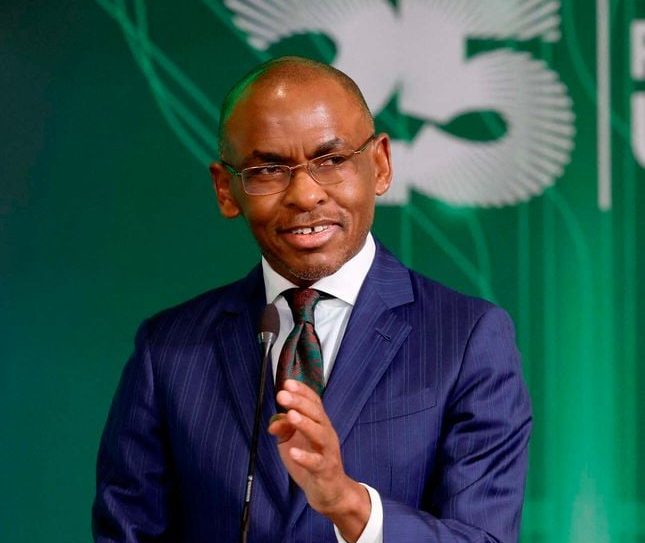
Kenya’s leading telecommunications giant, Safaricom, is facing mounting scrutiny after claims emerged that its board quietly extended the tenure of group CEO Peter Ndegwa without issuing any public communication, fueling outrage among shareholders, regulators, and consumer rights groups.
As of mid-April 2026, Ndegwa remains firmly in office despite his expected contract lapse on March 31, raising serious governance questions for one of East Africa’s most influential listed firms.
Governance Storm Over “Silent Extension”
The controversy stems from what critics describe as a troubling lack of transparency. Unlike previous leadership transitions, there has been no formal announcement regarding Ndegwa’s contract renewal, exit timeline, or succession plan.
Consumer lobby group Consumers Federation of Kenya has warned that the situation has devolved into “speculation and guesswork,” an unusual state for a publicly traded company of Safaricom’s stature.
“Shareholders deserve clarity. Silence on leadership succession is not just poor governance—it undermines confidence,” COFEK said in a statement.
Safaricom’s board charter reportedly caps CEO tenure at seven years, placing Ndegwa close to the upper limit, yet the company has offered no clarity on whether an extension has been formally approved.
A Sharp Departure from Past Leadership
The unfolding controversy stands in stark contrast to the transparent tenures of Ndegwa’s predecessors.
Founding CEO Michael Joseph oversaw a decade of structured growth before a clearly communicated exit in 2010, while his successor Bob Collymore had his contract extensions publicly announced in advance.
Both leaders maintained a clear governance framework that analysts say strengthened investor confidence and institutional credibility.
Ndegwa’s tenure, by comparison, is now being defined as opaque, with critics arguing that the absence of clear communication has eroded trust.
Internet Outage Sparks Lingering Questions
Public criticism intensified following the June 2024 nationwide internet outage, which coincided with Gen Z-led protests against the Finance Bill.
While Ndegwa attributed the disruption to undersea cable issues, monitoring groups disputed the explanation, noting inconsistencies in the scale and timing of the outage.
The incident drew condemnation from rights groups, including the Kenya Human Rights Commission, which later cited court orders barring internet shutdowns.
Although Ndegwa issued a public apology, the episode left lingering questions about whether external pressure may have influenced network operations.
Explosive Data Privacy Allegations
Further controversy erupted in October 2024 after investigative reports alleged that Safaricom had enabled security agencies to access customer call data records without proper judicial oversight.
The reports triggered strong reactions from civil society organizations, including Muslims for Human Rights, which accused the company of facilitating surveillance practices that could violate constitutional protections.
Safaricom denied the claims and defended its data handling practices, but tensions escalated after it reportedly withdrew advertising from Nation Media Group following the publication of the exposé.
Press freedom watchdog Reporters Without Borders criticized the move, warning of potential media intimidation.
Monopoly Concerns Resurface
Beyond governance and privacy issues, Safaricom is also under renewed scrutiny over its dominant market position.
Data from the Communications Authority of Kenya shows the company controls a majority share of mobile subscriptions and an overwhelming portion of mobile money transactions through M-Pesa.
Consumer advocates argue that such dominance stifles competition and disadvantages smaller players, calling for stricter regulatory oversight.
Ndegwa has previously dismissed such concerns, urging competitors to invest more aggressively—remarks that critics say overlook structural barriers in the market.
Rising Pressure on the Board
Despite the growing controversies, Safaricom continues to post strong financial performance, including record earnings and expansion into Ethiopia.
However, analysts warn that financial success alone may not shield the company from governance backlash.
“The issue is no longer just performance—it’s accountability,” a Nairobi-based market analyst noted. “Investors want transparency on leadership, especially in a company this critical to the economy.”
Calls for Transparency
Stakeholders are now demanding immediate action from Safaricom’s board, including:
- Public disclosure of Ndegwa’s contract status
- A clear succession roadmap
- Greater transparency on governance and oversight
For many Kenyans, the board’s silence has become the central issue.
As pressure mounts, the question remains whether Safaricom will address the concerns head-on—or continue to weather a storm that is rapidly escalating into one of the most contentious corporate governance debates in the country.
Safaricom’s leadership uncertainty, combined with unresolved scandals and growing monopoly concerns, has placed the telecom giant at a crossroads, where transparency and accountability may prove just as critical as profitability.