The government has awarded China Communications Construction Company (CCCC) a KSh375.4 billion ($2.9 billion) contract for the expansion and modernisation of Jomo Kenyatta International Airport (JKIA), marking one of Kenya’s most ambitious infrastructure undertakings in recent years.
The deal, which falls under the newly established National Infrastructure Fund (NIF), signals a renewed reliance on Chinese state-backed contractors for large-scale national projects following the collapse of a previous concession arrangement involving India’s Adani Group.
Although the government has not yet made a formal public announcement, sources familiar with the matter confirmed the award to Bloomberg, noting that preparations for the project are already underway.
Return of Chinese infrastructure dominance
The JKIA expansion deal comes months after President William Ruto announced that construction works would begin in June 2026, following the government’s mobilisation of seed capital for the NIF.
That seed funding includes KSh20 billion drawn from the privatisation proceeds of the Kenya Pipeline Company (KPC), part of a broader financing strategy meant to support long-term infrastructure development.
Chinese firms have long played a central role in Kenya’s infrastructure landscape, delivering major projects such as the Nairobi Expressway, the Standard Gauge Railway, and sections of key highways including the Rironi–Mau Summit corridor.
The latest award places China Communications Construction Company at the centre of Kenya’s most significant aviation infrastructure overhaul in decades.
A 20-year master plan for JKIA
The expansion and upgrade of JKIA will be implemented under a 20-year master plan running through 2045, designed to guide phased development, capacity expansion, and financial sustainability.
The plan envisions a transformation of the 68-year-old airport into a modern regional aviation hub capable of handling significantly higher passenger volumes and improved operational efficiency.
Two-phase expansion strategy
According to earlier government briefings, the project will be implemented in two major phases.
Phase one will focus on upgrading existing infrastructure, including taxiways, terminal processing areas, landside access routes, and digital airport systems. These upgrades are expected to increase JKIA’s capacity to approximately 12 million passengers annually within 18 months.
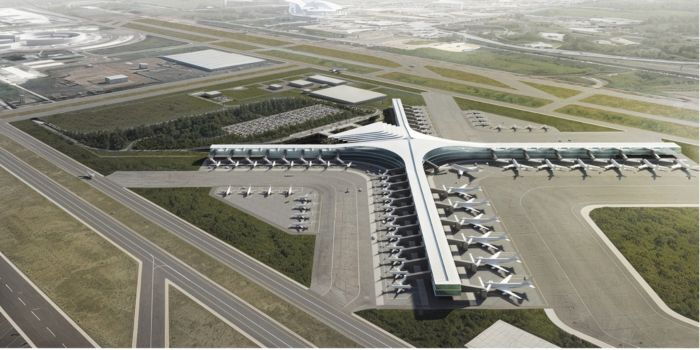
Phase two will involve large-scale expansion works, including the construction of a new 4,500-metre parallel runway and a 230,000-square-metre passenger terminal designed to handle an additional 10 million passengers per year.
The new terminal is expected to feature a modern X-shaped architectural design aimed at improving passenger flow, reducing congestion, and enhancing service efficiency.
Financing questions linger
While the contract award marks a major milestone, questions remain over how the government will finance the project beyond the initial KSh20 billion seed allocation from KPC proceeds.
It was not immediately clear how the remaining KSh355 billion required for the full implementation of the project would be mobilised, with analysts suggesting a mix of public-private partnerships, concessional financing, and infrastructure bonds may be considered.
Strategic economic implications
JKIA remains Kenya’s busiest and most critical aviation hub, serving millions of passengers annually and acting as a key gateway for trade, tourism, and regional connectivity.
The expansion is expected to strengthen Nairobi’s position as a leading aviation hub in Africa, particularly as competition intensifies from regional airports in Addis Ababa, Kigali, and Johannesburg.
The decision to proceed with a Chinese contractor also underscores Kenya’s continued strategic engagement with Beijing in infrastructure development, even as global financing models shift and scrutiny over debt sustainability remains high.
A major infrastructure gamble
The project is widely seen as both a strategic opportunity and a financial test for the government’s infrastructure agenda.
If successfully implemented, the JKIA expansion could significantly reshape Kenya’s aviation capacity and economic outlook for decades. However, the scale of financing required and the complexity of execution place it among the most challenging public infrastructure projects undertaken in the country.
As the project moves from announcement to implementation, attention will now shift to procurement transparency, financing clarity, and delivery timelines.
For now, Kenya has once again turned to China for one of its biggest infrastructure bets yet—this time at the heart of its busiest airport.