Home Tags Posts tagged with "Supreme Court"
Tag:

Supreme Court

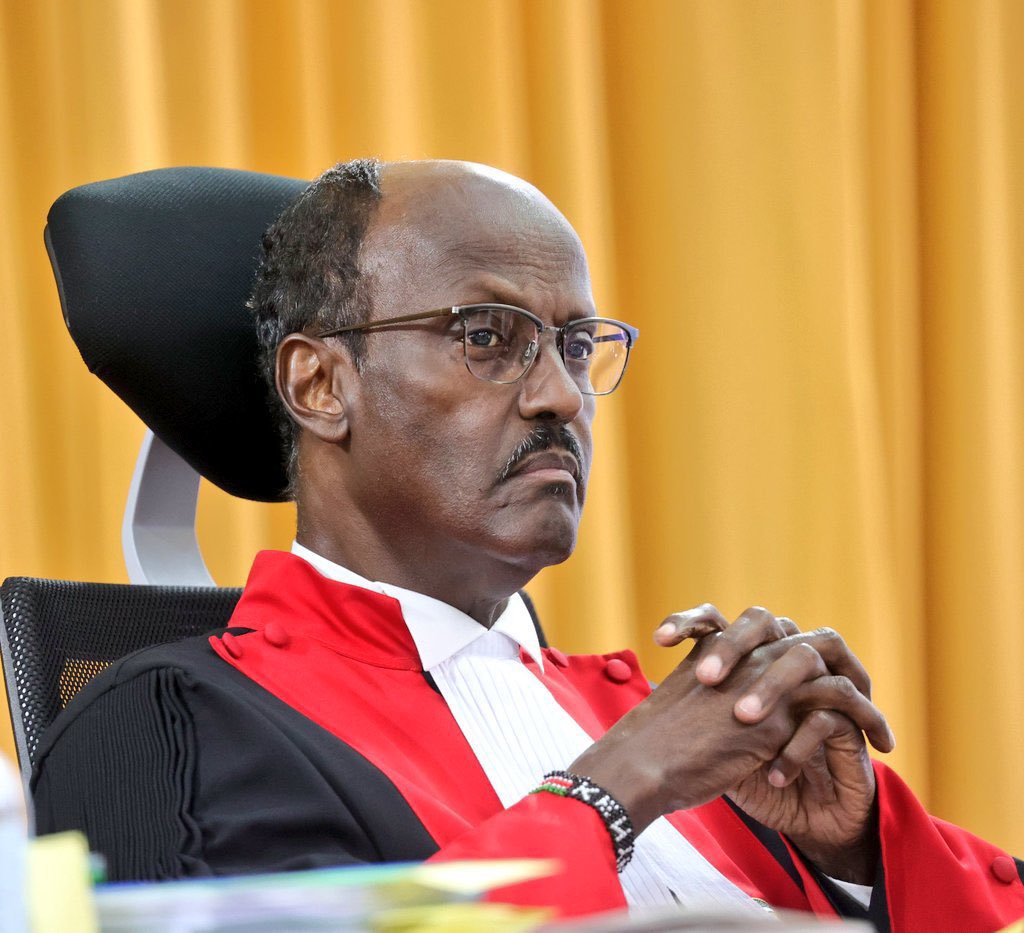
Justice Mohamed Ibrahim

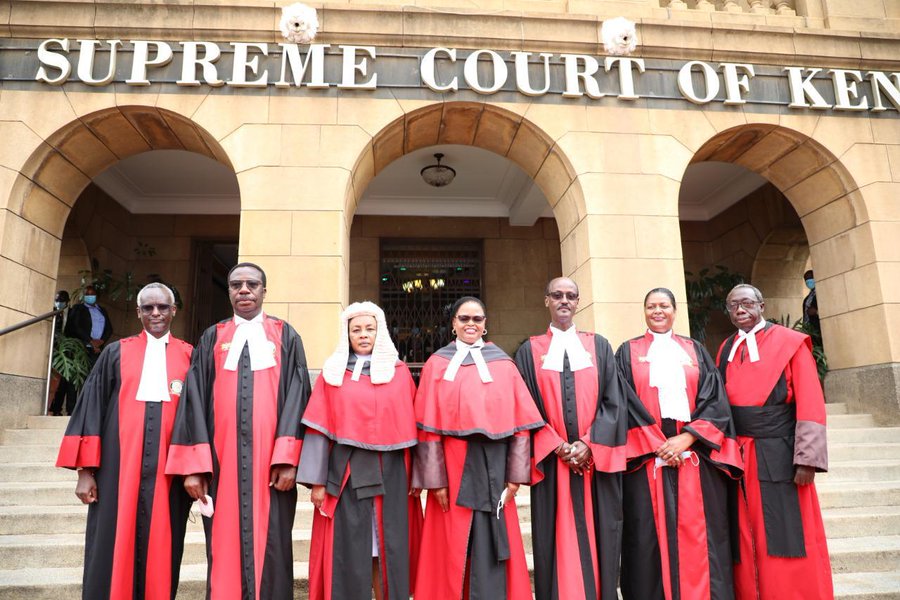
Kenyans and leaders have continued to send their tributes after the legal fraternity was thrown into mourning on Wednesday, December 17, 2025, following the death of Supreme Court Judge Mohammed Ibrahim.

Justice Mohamed Ibrahim passed away shortly after 4.30 pm.

Sources close to the family said Justice Ibrahim had been receiving treatment in an Intensive Care Unit in India, but doctors advised that he be returned home to Kenya for his final days.

His death marks the end of a distinguished judicial career and a profound loss to Kenya’s justice system.

Chief Justice Martha Koome mourned him as a jurist of exceptional humility and integrity, saying he will be remembered as a steadfast guardian of constitutionalism, electoral justice, and human dignity.

“The Judiciary, the Supreme Court and the JSC mourn the loss of a distinguished jurist whose legacy bridges courageous advocacy and principled judging, and whose life exemplified fidelity to his oath of office, service to country, and compassion for the voiceless,” CJ Koome said.

“We stand in solidarity with his family, friends, and the entire Judiciary community during this difficult period of mourning, and we call for sensitivity and compassion as we share in this collective grief.”

National Assembly Speaker Moses Wetang’ula has mourned Justice Ibrahim as one of the inaugural judges of the Supreme Court of Kenya, with a highly decorated career in the legal industry spanning over 34 years.

According to Wetang’ula, Justice Mohamed Ibrahim will be remembered for his active role in bringing social justice and fighting for minority groups to have equal rights, and he often offered pro bono services

“I am saddened to learn of the demise of Hon. Justice Mohammed Ibrahim, Judge of the Supreme Court of Kenya, after a long illness. Hon. Ibrahim was one of the inaugural judges of the Supreme Court of Kenya with a highly decorated career in the legal industry spanning over 34 years. He will be remembered for his active role in bringing social justice and fighting for minority groups to have equal rights, and often offered pro bono services. His loss is a monumental one for the legal industry and the Judiciary at large. Inna lillahi wa inna ilayhi raji’un,” Wetang’ula stated.

Nairobi County Senator and ODM Secretary General Edwin Sifuna has also mourned Justice Ibrahim.

“My thoughts are with the family of the Honorable Justice Mohammed Ibrahim. May his soul rest in eternal peace. Innalillahi wa inna ilaihi rajiun,” Sifuna wrote on X.

Law Society of Kenya (LSK) President Faith Odhiambo, in her message of condolence, said that Justice Ibrahim’s rare calmness spoke of a man who fully understood the role of judicial authority as an opportunity to serve, and the nuances of justice as a tool for maintaining social order.

“I have received the sad news of the passing on of Hon. Mr. Justice Mohammed Ibrahim, SCJ. Justice Ibrahim served in the bench with unparalleled grace and distinguished intellect. His rare calmness spoke of a man who fully understood the role of judicial authority as an opportunity to serve, and the nuances of justice as a tool for maintaining social order. His passing on is a big loss to the Supreme Court, the Judiciary, and to the administration of Justice in Kenya,” Faith Odhiambo stated.

“Justice Ibrahim was a towering source of inspiration to all who dared to dream. He was the first person from the Kenyan-Somali community to be admitted to the Bar, at a time when his community was among the most marginalised in Kenyan society. He dedicated much of his early career to the defence of human rights and promoting the ideals of a fair and equal society. He carried his record of excellence and ethical conduct throughout his near-decade-long tenure as a Judge of the High Court.”

Justice Mohamed Ibrahim’s Biography: Life, Education and Career

Justice Ibrahim was appointed to the Supreme Court of Kenya on June 16, 2011, becoming one of the court’s founding judges following the promulgation of the 2010 Constitution.

From the outset, he played a central role in shaping the jurisprudence, institutional culture, and public-facing mandate of the country’s apex court during a formative period for constitutional democracy.

Within the Supreme Court, Justice Ibrahim held extensive administrative and governance responsibilities.

He served as Chairperson of the Judiciary Committee on Elections, a role that placed him at the heart of judicial preparedness and oversight during electoral cycles, an especially sensitive and consequential area in Kenya’s constitutional order.

He also oversaw the establishment of the Court’s ad hoc Committee on Elections, strengthening internal coordination and accountability.

His portfolio further included liaison with internal judicial stakeholders such as the Kenya Magistrates and Judges Association (KMJA), the Kenya Women Judges Association (KWJA), and the Judiciary Staff Association.

Through this work, he was instrumental in fostering cohesion across the Judiciary and amplifying institutional dialogue on judicial welfare, independence, and professional standards.

Justice Ibrahim also coordinated the Supreme Court’s engagement with non-state actors, with particular reference to civil society and marginalised groups.

This role reflected a broader commitment to accessibility, inclusion, and public confidence in the administration of justice.

He additionally oversaw Supreme Court publications, annual reports, and library management, ensuring that the Court’s work was documented, accessible, and grounded in robust legal scholarship.

As part of the Court’s leadership team, he contributed to the development, monitoring, and evaluation of the Supreme Court Strategic Plan, embedding feedback mechanisms to strengthen institutional performance and responsiveness.

He also served as the critical link between the Supreme Court and the Judiciary Committee on Elections, reinforcing coordination across judicial structures.

Justice Mohammed Ibrahim will be remembered as a jurist who combined administrative rigour with a quiet commitment to inclusion and institutional integrity.

His legacy endures in the structures he helped build, the standards he upheld, and the communities that saw in him both representation and service at the highest level of justice.

Justice Mohammed Ibrahim studied law at the University of Nairobi before entering private legal practice.

In November 1982, he joined the firm of Messrs Waruhiu & Muite Advocates and was admitted to the Roll of Advocates on January 11, 1983, becoming the first Kenyan Somali to be admitted to the Bar as an advocate.

He rose through the firm to become a salaried partner in 1985 and a full partner in 1987. In 1994, he established Mohammed Ibrahim & Associates, which later expanded into Ibrahim & Isaack Advocates in 1997.

The firm litigated civil and constitutional cases and specialised in banking, company law, bankruptcy, commercial law, property law, conveyancing, and insurance law.

During private practice, he was active in defending minority rights, particularly those of the Somali community.

He challenged the government’s use of “pink cards,” secondary identity documents that required additional citizenship verification and were seen as discriminatory against Kenyan Somalis.

Justice Ibrahim was appointed a Judge of the High Court on May 22, 2003. He served in the Civil and Commercial Divisions at Milimani, Nairobi, before joining the Judicial Review and Constitutional Division in 2004.

He was later transferred to Eldoret, where he served as Resident Judge between 2007 and 2009, handling matters across the North Rift Valley and occasionally assisting the High Court in Kisii.

In July 2009, he was transferred to the High Court in Mombasa as Resident Judge before his elevation to the Supreme Court of Kenya.
0 comment
0 FacebookTwitterPinterestLinkedinTumblrWhatsappTelegramEmail

Former Cabinet Minister Raphael Tuju has delivered a damning indictment of the Supreme Court of Kenya (SCoK), calling out judges for reckless rulings, corruption, and public drunkenness. He warns that their irresponsible decisions are driving Kenya toward collapse.

Supreme Court’s 2022 Election Ruling: The Judges Who Played with Fire

Tuju blasts the Supreme Court’s handling of the 2022 presidential election petition, condemning the judges for using dismissive, inflammatory language such as “hot air” and “wild goose chase.” He says these reckless words fueled division and tension in a country already on edge.

Drawing a parallel to pre-Civil War America—where controversial judicial rulings fanned the flames of conflict—Tuju warns that the Supreme Court’s arrogance could plunge Kenya into chaos. He reminds the judges that Kenya is still in a fragile phase of nation-building and that their careless decisions could trigger state failure, just like in Somalia or South Sudan.

Kenya’s Judiciary: Bought by Banks and Powerbrokers

Tuju takes direct aim at the Supreme Court, accusing it of siding with banks and big money over justice. In his own land dispute case over a 27-acre Karen property, he says judges ruled against him without giving him a fair hearing. Even worse, they claimed he could be compensated later if he won—an argument Tuju calls immoral and a direct assault on property rights.

He exposes how Kenya’s top lawyers, including Senior Counsel Githu Muigai, manipulate the system for personal gain. As a former Attorney General, Muigai allegedly pushed laws that now benefit his private clients in court. Tuju paints a picture of a judiciary controlled by corrupt lawyers and judges more interested in lining their pockets than serving justice.

Drunk on Power—And on Alcohol

Tuju drops a political bombshell: four out of seven Supreme Court judges have been seen drunk in public. He challenges them to deny it, offering to provide video evidence of these judges making incoherent statements while intoxicated. How can Kenyans trust their highest court when its judges are more familiar with bars than legal books?

He demands accountability, challenging Chief Justice Martha Koome to explain how she allows such disgraceful conduct. He calls on the Judiciary to clean up its act and restore dignity to Kenya’s courts.

Judges Aiding Land Grabbing?

Tuju insists that his Karen land was legally acquired and not tied to corruption or public funds. Yet he reveals a web of corrupt lawyers, auctioneers, and officials who conspire to steal private property through fraudulent court rulings. He accuses the Supreme Court of actively enabling this criminal enterprise.

The judges’ decision to back this injustice, he argues, is clear proof that judicial corruption is alive and thriving. If someone as prominent as him can be robbed in broad daylight, what chance does the ordinary Kenyan have against this broken system?

Judicial Impunity Must End—Now

Tuju warns that Supreme Court judges are shielding themselves from accountability by weakening the Judicial Service Commission (JSC), the only body tasked with keeping them in check. He calls this a direct assault on Kenya’s Constitution.

He reminds Chief Justice Koome that no judge is above the law and demands immediate action to purge corruption and misconduct from the Judiciary. The days of untouchable, arrogant judges must come to an end.

Kenyans Must Ask: Who Really Runs Our Courts?

Tuju’s explosive allegations reveal a judiciary riddled with corruption, bias, and drunken incompetence. Can Kenyans trust their highest court when its judges are in the pockets of banks, powerbrokers, and alcohol? Should a Supreme Court with unchecked power continue deciding the country’s future?

His letter has put the Judiciary under intense scrutiny. The big question now: Will Chief Justice Koome take action—or will she let the rot continue?

0 comment
0 FacebookTwitterPinterestLinkedinTumblrWhatsappTelegramEmail

More Kenyan marriages may soon end in premium tears.

This follows the latest supreme court ruling that was delivered by Supreme Court judges Philomena Mwilu, Smokin Wanjala, Njoki Ndungu, Isaac Lenaola and William Ouko.

According to the Apex Court judges, the doctrine of presumption of marriage is on its deathbed following changes to the matrimonial laws in Kenya.

So where does this leave Kenyans who have been in come we stay marriages for a very long time?

Well, the court said the presumption of marriage should only be used sparingly where there is cogent evidence to support it.

Therefore, no matter how long you live together with your spouse in a come we stay set up, it cannot be recognized as marriage.

“It is becoming increasingly common for two consenting adults to live together for long durations where these two adults have neither the desire, wish nor intended to be within the confines of matrimony,” they said.

“Where such a situation is evident and there is no intention whatsoever of contracting a marriage, the presumption of marriage must never be made where this intention does not exist. It must always be remembered that marriage is a voluntary union. As such, courts should shy away from imposing ‘marriage’ on unwilling persons,” they added.

They said they recognise that there exist relationships where couples cohabit with no intention whatsoever of contracting a marriage.

For instance, the court observed that a person may have been in a marriage before and the marriage is no more due to the death of a spouse or divorce and due to their prior experiences, such persons may choose to have an interdependent relationship outside of marriage.

For others, the judges said, it may just be their desire never to marry but have a partner without the confines of marriage.

The judges urged the National Assembly, the Senate and the Attorney-General to formulate and enact Statute law that deals with cohabitees in long-term relationships, their rights, and obligations.

This ruling stems from a dispute between two long cohabitees who were fighting for an equal share of a property that they jointly acquired.

The case was first instituted by the man against the woman whom he claimed to be his wife.

His arguments were that they began cohabiting as husband and wife sometime in 1986 and that from joint savings, they purchased a property that later became the bone of contention after he was evicted from it.

0 comment
0 FacebookTwitterPinterestLinkedinTumblrWhatsappTelegramEmail

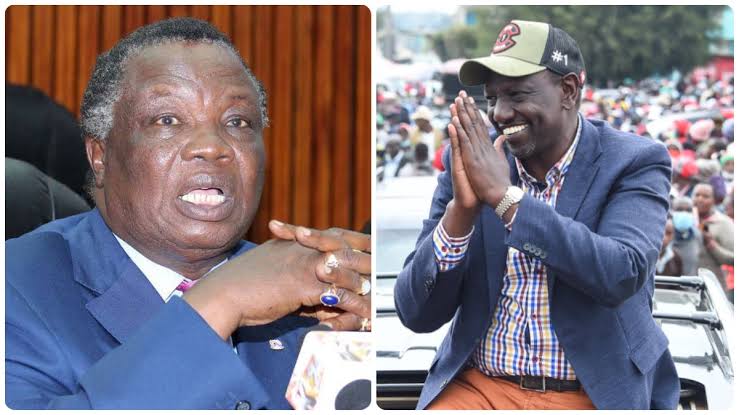
COTU Secretary General Francis Atwoli has broken his silence moments after the Supreme Court of Kenya upheld President elect William Ruto’s Win.

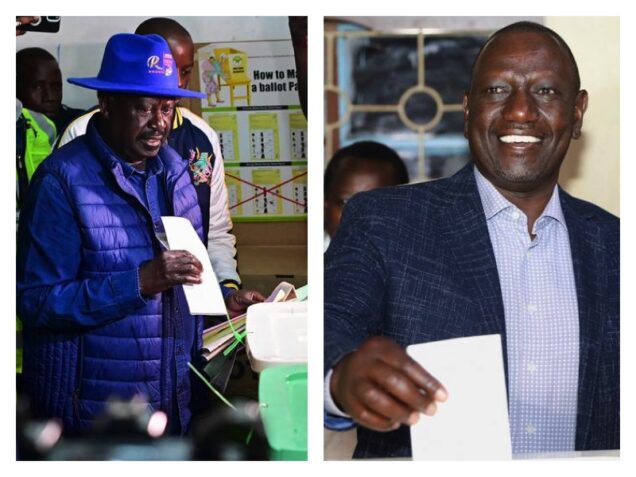
The Chief Justice Martha Koome-led court on Monday afternoon ruled that the Independent Electoral and Boundaries Commission (IEBC) had conducted a free, fair and verifiable election.

Atwoli has been heard confidently saying that Ruto will not become the president of the republic of Kenya.

The COTU boss has maintained his remarks during the Azimio la Umoja-One Kenya Coalition campaigns, and before that, he had even been heard saying that Ruto will not be on the ballot.

However, after the Supreme Court verdict, Atwoli took to his official social media handles and congratulated President elect Ruto.

Atwoli noted that COTU had unanimously agreed during their executive board meeting that they would thank and Congratulate the victor.

He went ahead to appeal to the workers and Kenyans at large to remain peaceful after the Supreme Court verdict.

“During COTU (K) Executive Board meeting on 17th August, we resolved THAT immediately after the Supreme Court judgement, we must thank and congratulate the victor. Consequently, we congratulate President William Ruto. We appeal to workers and Kenyans in general to remain peaceful,” Atwoli tweeted.

0 comment
0 FacebookTwitterPinterestLinkedinTumblrWhatsappTelegramEmail

Azimio la Umoja-One Kenya Coalition allied leaders have expressed their confidence ahead of the election petition that will be filed at the Supreme Court on Monday.

The Azimio allies drawn from the Western Kenya region have maintained that they will fight until their presidential candidate Raila Odinga becomes the 5th president of Kenya.

The coalition is set to challenge the election of William Ruto who was declared the president-elect in the just concluded General election.

While condoling with the family of Nairobi senator elect Edwin Sifuna who lost his grandmother Lukelesia Nafula Sifuna, Godfrey Osotsi, the senator elect for Vihiga County on ODM party ticket said that they have gathered enough evidence which they will use against the Kenya Kwanza team.

Osotsi went ahead to ask for electoral justice saying that the voters’ decisions must be respected.

He faulted the Independent Electoral and Boundaries Commission (IEBC) chairman Wafula Chebukati for going against the will of the people.

“It cannot be always that when Kenyans demonstrate their democratic right by voting, some few individuals like Chebukati ends up deciding for them who to be their president and that’s why we as AZIMIO One Kenya we are going to seek for a solution constitutionally to tackle those who were involved in this malicious act,” he said.

He went ahead to call out the president elect for going against the law by accepting  other political parties from AZIMIO One Kenya  to join Kenya Kwanza saying that he is manipulating them with money to join him and so risking losing  their seats according to the political parties act that says that they are not supposed to do so.

“I want to tell the deputy president to slow down, he is yet to be the president and he might not be because I believe that the Supreme Court is going to nullify it. We have enough evidence to show that the tallying process was corrupt and so where we stand as a country, we are yet to know who the president is,” he said.

His sentiments were echoed by Edwin Sifuna who said that the decision now lies in the hands of the supreme court and as AZIMIO One Kenya, they have prepared adequately and they are sure that justice will prevail.

0 comment
0 FacebookTwitterPinterestLinkedinTumblrWhatsappTelegramEmail

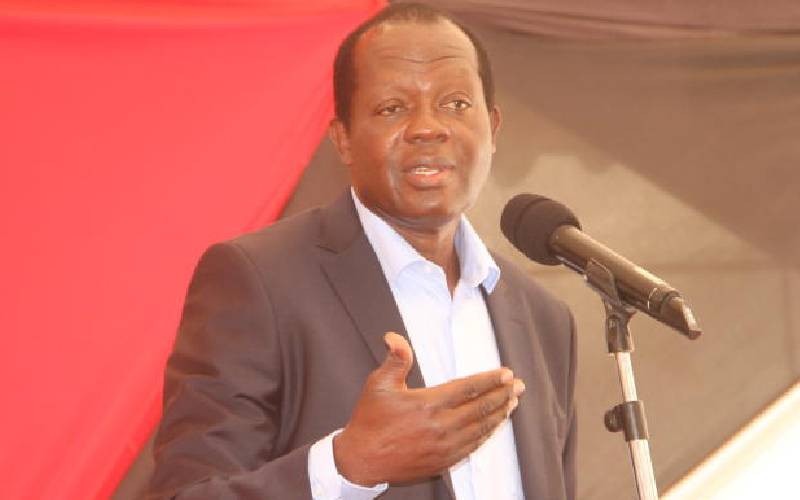
Impeached Kiambu county governor Ferdinand Waititu on Monday moved to the Supreme Court to contest the decision to lock him out of office.

Waititu claims in the notice of appeal to the apex court that he is dissatisfied with the Court of Appeal’s decision last Friday to uphold his suspension, claiming that it amounted to removing him from office through the back door.

“Being dissatisfied with the entire decision of the Appellate Court, the applicant is seeking the Supreme Court’s intervention to enforce his rights as an elected governor and those of Kiambu people who stand to suffer if the decision is not overturned,” read the notice of appeal.

Appellate Judges Daniel Musinga, Agnes Murgor and Gatembu Kairu on Friday upheld a High Court decision, which suspended Waititu and Samburu Governor Moses Lenolkulal from office after they were charged with embezzling public funds.

Also Read: Blow to Governor Lenolkulal as DPP Demands Cancellation of His Bond

The governor was charged in July with conspiracy to steal Sh58 million from Kiambu County during the award of a Sh588 million tender for roads construction.

He was charged alongside his wife Susan Wangari Ndun’gu, former County Chief Officer for Roads Luka Mwangi, businessman Charles Chege and his wife Beth Wangeci as well as six county employees.

The trial magistrate then barred Waititu from accessing his office as a condition for being released on bail.

The ruling was upheld by High Court Judge Grace Ngenye who declared that the governor should not set foot in the county offices until the corruption case is concluded.

Judges Musinga, Murgor and Gatembu ruled that public interest outweighed the two governors’ individual rights to access their offices.

“We find nothing wrong with the lower court’s decision to bar the governors from accessing their offices. As much as it will be inconveniencing to them, we find that it is necessary to impose the conditions to safeguard public resources and the court’s integrity,” ruled the judges.

People Also Read; Revealed: Here is where Waititu was ‘hiding’ the whole of Saturday

According to the judges, it would be wrong to allow Waititu to set foot in the same offices he is accused of committing the crimes and interact with the same witnesses, who are his junior staff, scheduled to testify against him.

On the issue of a vacuum being witnessed at the counties due to the governors’ absence, the judges stated that the constitution already has a provision for deputy governors to take over functions of running county affairs in the absence of their bosses.

“There is absolutely no fear of vacuum in leadership in the absence of a governor. We have had instances where the governor is having ill-health and their deputies take over. The law provides that the deputies can run the affairs if the governor is absent,” ruled the judges.

0 comment
0 FacebookTwitterPinterestLinkedinTumblrWhatsappTelegramEmail

Kirinyaga Governor Anne Waiguru on Tuesday beat former presidential aspirant Martha Karua in a supreme court battle.

The bench ruled that the eloquent governor would continue carrying out her gubernatorial duties.

“God has been on our side, it was among the last case to be determined and I think. We won this election fairly, people of Kirinyaga put their trust in us,” Waiguru divulged.

“I think Martha Karua should finally accept and put this matter to rest, it is unfortunate that we have had to take two years of a court process that has costed a lot of money,” she added.

0 comment
0 FacebookTwitterPinterestLinkedinTumblrWhatsappTelegramEmail